Water damage, mold, asbestos and lead — assessed by us, abated by licensed specialists.
Diagnose it first: Water Leaking Through the Ceiling: Who to Call First, and Who Repairs What Is Left · The Toilet Overflowed and the Plumber Has Been. Is the Floor Ruined? · Does Homeowners Insurance Cover the Damage After a Pipe Leak? What Is Usually In, What Is Usually Out.
Quick answer: Water, Mold and Hazard Remediation in Charleston, SC. Southeastern Renovation is a licensed South Carolina general contractor (CLG.127339) serving the Charleston Lowcountry and York County, SC. Work is coordinated by Southeastern Renovation as the general contractor. Licensed trade subcontractors handle work requiring their trade credentials; permit responsibilities depend on the project scope and jurisdiction. Call (843) 718-8177 for an estimate.
Southeastern Renovation is a division of Southeastern Renovation LLC, the Charleston general contractor behind Southeastern Renovation (SC Lic. CLG.127339). Work is coordinated by Southeastern Renovation as the general contractor. Licensed trade subcontractors handle work requiring their trade credentials; permit responsibilities depend on the project scope and jurisdiction.
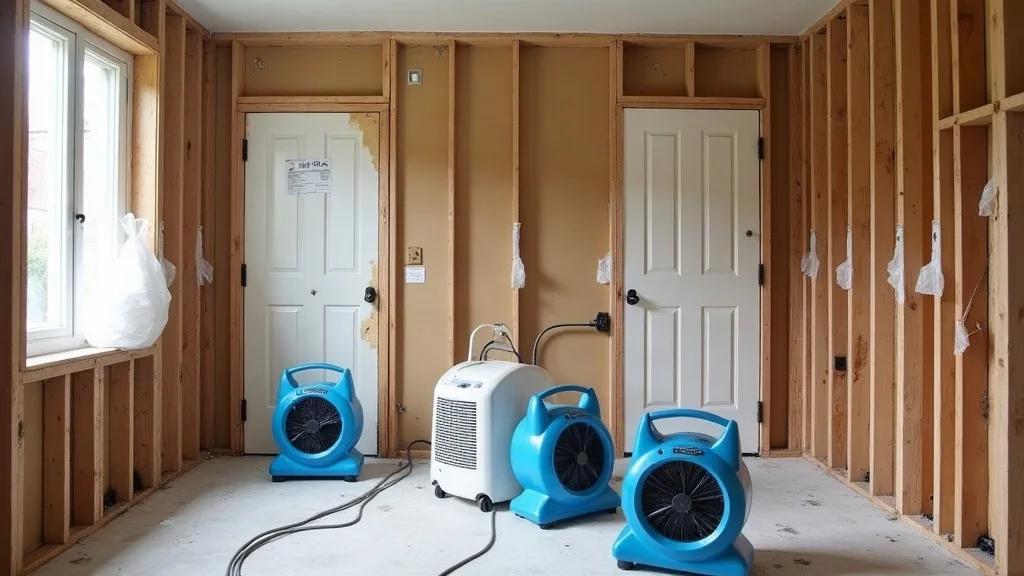
Restoration work goes wrong when it is done out of order, and the order is not complicated. Stop the water. Establish what is wet, with a meter rather than a hand, because wall cavities, insulation and subfloors hold water long after a surface feels dry. Dry to a measured target and document it. In a building of any age, test before demolition rather than during it. Only then rebuild.
The middle step is the one that gets skipped and the one that turns a water loss into a mould problem. It is also why "how long will the dryers be here" is answered by readings rather than by a fixed number of days — the equipment stays until the material reaches target, and a contractor who commits to a duration before taking a reading is committing to something they cannot know.
The same volume of water produces two very different scopes at twelve hours and at two weeks. Time is what moves material from dryable to removable.
Clean supply water, water that has passed through building materials, and sewage are handled to three different standards. It changes what can be dried in place and what has to be discarded, and it is not a judgement call.
Drying a cavity often means removing a controlled amount of finish to reach it. That removal, and the rebuild that follows it, is normally the larger part of a water loss.
In an older house, suspected asbestos-containing material and lead paint change who may legally do the work. Testing costs little; assuming costs a great deal, because an assumption discovered mid-demolition stops the job.
Asbestos abatement is separately licensed work in South Carolina and we do not self-perform it. We identify it, stop, bring in a licensed abatement contractor, and resume once the area is cleared. On lead, the federal rule is the binding one: under the EPA's Renovation, Repair and Painting programme, anyone paid to perform work that disturbs painted surfaces in a home built before 1978 must be a certified firm using trained renovators. Given the age of a good deal of housing in both the Lowcountry and York County, that is a routine part of renovating here rather than an exceptional event.
The rebuild is ordinary contracting and sits with us: drywall, trim, flooring, paint, and the plumbing, mechanical or electrical repair that caused the loss in the first place, each pulled and permitted by the licensed trade performing it. Where an insurance claim is involved, the scope has to be documented in a form an adjuster can work from, and producing that documentation is part of the job — not a promise about what a carrier will pay, which is between you and them.
Southeastern Renovation contracts the job under general contractor licence CLG.127339. Restoration is the clearest case for the structure: it crosses assessment, licensed abatement, licensed trade repair and a full interior rebuild, and the failure mode is a handoff, not a task. One contract, one scope, one party accountable for the sequence.
No. Abatement is separately licensed work here.
We identify it, stop, bring in a licensed abatement contractor and resume afterwards, which is a routine part of renovating older houses in Charleston rather than a disaster.
Because the moisture that grew it is still there. In this climate it is often a crawl space or ductwork sweating rather than a leak, and a clean that does not change the conditions is a schedule rather than a fix.
Moisture readings rather than touch. Wall cavities, insulation and subfloors hold water long after a surface feels dry, and that is where a water loss turns into a mold problem.