Charleston Lowcountry
Pressure Washing in Charleston, SC
Pressure washing, house washing and the mildew that grows back every summer.
Pressure washing, house washing and the mildew that grows back every summer.
Quick answer: Pressure Washing in Charleston, SC. Southeastern Renovation is a licensed South Carolina general contractor (CLG.127339) serving the Charleston Lowcountry and York County, SC. Work is coordinated by Southeastern Renovation as the general contractor. Licensed trade subcontractors handle work requiring their trade credentials; permit responsibilities depend on the project scope and jurisdiction. Call (843) 718-8177 for an estimate.
Southeastern Renovation is a division of Southeastern Renovation LLC, the Charleston general contractor behind Southeastern Renovation (SC Lic. CLG.127339). Work is coordinated by Southeastern Renovation as the general contractor. Licensed trade subcontractors handle work requiring their trade credentials; permit responsibilities depend on the project scope and jurisdiction.
And why most of what needs washing should not be pressure washed.
Soft washing the whole exterior, and why it comes back.
The black streaks are algae — and the roof must never be pressure washed.
Inside, outside, and the screens and tracks that make the difference.
Almost everything sold as pressure washing should not be pressure washed. High pressure is appropriate for concrete, driveways, paths and sound masonry. It is not appropriate for siding, painted surfaces, timber or roofs, where it drives water behind cladding, tears up softwood grain and — on an asphalt roof — strips the mineral granules that are the roof's ultraviolet protection. A roof washed that way can look excellent on the day and have had years taken off it.
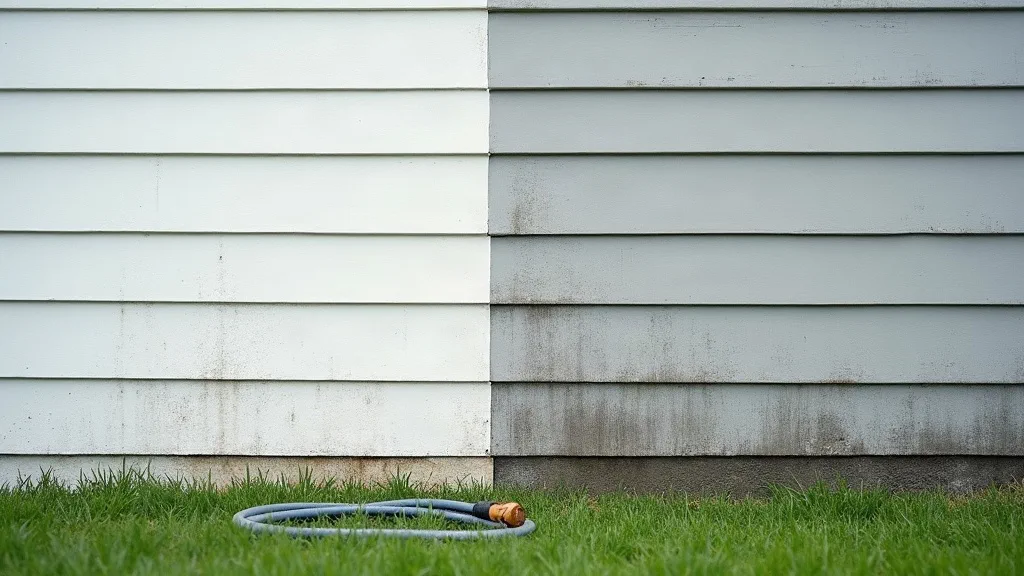
The alternative is soft washing: low pressure, and a cleaning solution that kills the growth rather than blasting the visible part of it off. That distinction is also the answer to why it comes back. The black streaking on a roof and the grey film on a shaded north elevation are living organisms, and the humidity, shade and still air that grew them are still there afterwards. A wash that removes only what is visible leaves what it regrows from, which is why the method matters more than how the house looks the afternoon the crew leaves.
Reach is the cost. A single-storey ranch and a three-storey house with a wrap-around porch are not the same job per square foot, and anything requiring a lift or roof access changes the safety scope as well as the time.
A house with fibre cement, brick, painted trim, a composite deck and a concrete drive needs four approaches and four dwell times. That is why a flat per-square-foot number rarely survives contact with a real property.
Light seasonal film rinses off. Years of established growth on a shaded elevation needs dwell time and often a second pass, and it is fair for a quote to say which of those it has priced.
Planting, light fittings, air conditioning coils and open vents all need covering or rinsing. Where the washwater goes is a stormwater question worth asking about, and containment is part of a competent method rather than an extra.
Exterior cleaning is not a licensed construction trade in South Carolina. It is not among the residential specialty classifications the state defines, and no wash needs a building permit, so the usual verification route does not exist here. What replaces it: general liability cover, workers' compensation for anybody going up a ladder or onto a roof, and a written method statement saying which surfaces get pressure and which get a soft wash. On a roof in particular, ask the manufacturer's position — cleaning a roof the wrong way can affect a shingle warranty, and that is worth knowing in advance.
One federal rule does reach this work. Where washing is the first step of repainting a home built before 1978 and the process disturbs paint, that job falls under the EPA's Renovation, Repair and Painting programme, which requires a certified firm and trained renovators. It is the reason a wash-and-repaint on an older house is quoted differently from a wash on its own.
Southeastern Renovation is a general contractor, licence CLG.127339, which is why we say no to some of this work. A wash frequently uncovers what it was hiding — failed caulk, soft trim, a rotten sill, siding that has been letting water in for years. A cleaning-only firm reports it. We can price and fix it, and where the work needs a licensed trade, a licensed subcontractor performs it and pulls their own permit.
No. High pressure strips the mineral granules off asphalt shingles, and those granules are the roof’s UV protection.
A roof washed that way can look excellent and have had years taken off it.
Because the humidity, shade and still air that grew it are still there. A wash that removes only the visible growth leaves what it regrows from, which is why the method matters more than the result on the day.
Concrete, driveways, paths and sound masonry, generally. Siding, paint, timber and roofs generally cannot.