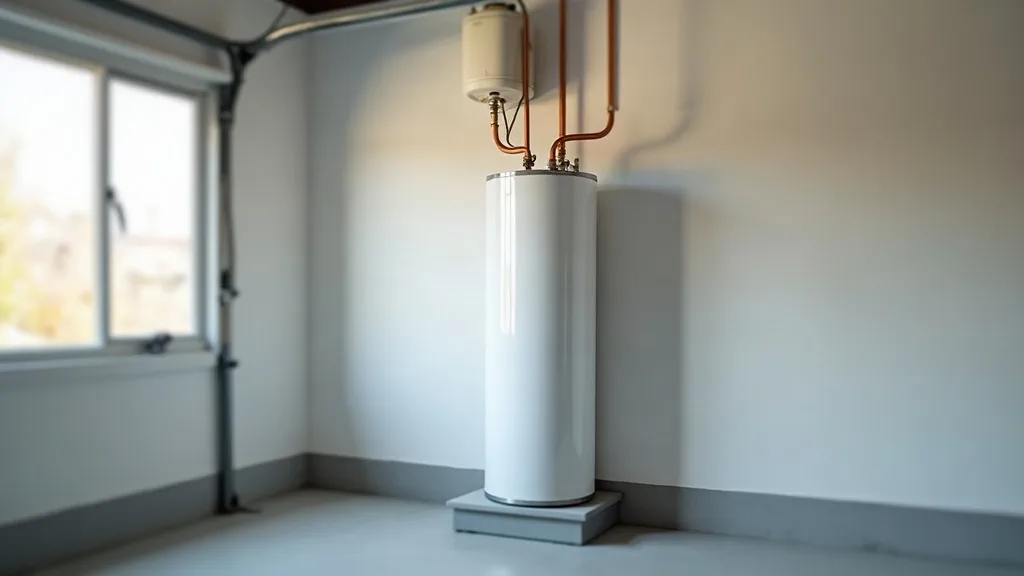
The comparison · Charleston & York County
Tankless vs Tank: Which One Should You Actually Buy?
Every page in this market answers yes. The real answer depends on three things about your house.
Every page in this market answers yes. The real answer depends on three things about your house.
Quick answer: Switch to tankless if you are running out of hot water, want the floor space, or the tank has already failed and the gas line and vent are being opened anyway. Keep the tank if it is healthy, if there is no gas at the house, or if the only reason you are considering it is the energy saving — which ENERGY STAR puts at $95 a year for a family of four, against a retrofit premium published locally at $3,800 to $6,400 in the Charlotte metro. And if you are on electricity rather than gas, the appliance with real rebate money behind it in South Carolina is neither of these — it is a heat pump water heater. Call (843) 718-8177.
The comparison is usually presented as tankless versus tank, efficiency versus cost, modern versus old. That framing is why so many people are disappointed with the one they chose.
The useful comparison is narrower. There are three questions, and the answers to them decide it before any brochure does: are you actually running out of hot water, is there gas at the house, and is the existing heater dead yet.
A correctly sized tankless unit will run a shower until the water bill hurts. It does not have a recovery time, so back-to-back showers and a bath in the evening are the same to it as one shower.
On life, ENERGY STAR says: “Tankless water heaters have a life expectancy of 20 years, much longer than any conventional tank-type water heater.” (ENERGY STAR — tankless gas water heater benefits and savings). The Department of Energy’s guidance put tankless above twenty years against ten to fifteen for a tank — quoted from U.S. Department of Energy, Energy Saver (archived 30 June 2026 — page since removed), because that page has since been removed from energy.gov entirely.
And it hangs on a wall. In a Lowcountry house where the heater is in a closet off the kitchen, that closet is worth something.
Published Charleston prices: a 50-gallon tank replacement at $1,550 to $2,800 (Swell Guy Plumbing Co. published price ranges) against $2,850 to $4,500 for a new gas tankless installation (Swell Guy Plumbing Co. — tankless installation). In the Charlotte metro the gap is wider — a plumber there publishes tankless at $6,228 to $6,875 fully installed and puts the premium over a conventional tank at $3,800 to $6,400 (Full Spectrum Plumbing Services, Charlotte — what a tankless really costs).
A tank is also simpler to fault-find, simpler to replace in an emergency, and does not care whether the power is on.
This is the failure people describe when they say a tankless unit disappointed them. A tank does not care how many taps are open; it just empties faster. A tankless unit has a flow rate, and exceeding it means everyone gets lukewarm water at once rather than one person getting cold water last.
It is a sizing problem, not a technology problem, and it is the most common one. Sizing has its own page.
The efficiency gain is real. The archived DOE guidance: “For homes that use 41 gallons or less of hot water daily, demand water heaters can be 24%–34% more energy efficient than conventional storage tank water heaters. They can be 8%–14% more energy efficient for homes that use a lot of hot water — around 86 gallons per day.” (U.S. Department of Energy, Energy Saver (archived 30 June 2026 — page since removed)). DOE’s surviving Building America page puts it at about a third: “Although tankless gas water heaters should save approximately 33% on hot water heating compared to a conventional storage water heater, actual energy savings vary significantly based on individual draw volume … The greatest savings occur at a daily use quantity of about 50 gallons.” (U.S. Department of Energy — Building America Top Innovations, tankless gas water heater performance).
Then ENERGY STAR converts it into money, which is the number that settles it: “By heating water only when you need it, ENERGY STAR certified tankless water heaters save a family of four $95 per year, or $1,800 over its lifetime, on gas bills compared to a standard gas storage model.” (ENERGY STAR — tankless gas water heater benefits and savings).
At $95 a year against a retrofit premium in the thousands, the arithmetic does not close on energy alone, and we are not going to pretend it does. Buy one for the endless hot water and the floor space. The fuel saving is a rounding error next to the install.
⚠️ A condensing unit is about 9% more efficient again than a non-condensing one, and it is the condensing unit that needs the PVC vent and the condensate drain. The efficiency and the installation cost move together; you do not get to pick one.
If the house has no gas, the comparison is not tankless against tank. It is heat pump water heater against everything else, and in South Carolina it is the one with money attached.
The rebates in this state are pointed at heat pump water heaters, not tankless ones. Santee Cooper pays $400 for one, and Duke Energy’s programme says in as many words that the rebate is not available on tankless water heaters. If a rebate is what decides your purchase, the honest answer is that you are looking at the wrong appliance.
Berkeley Electric Cooperative runs a storage programme of its own: Berkeley Electric Cooperative pays $300 on a new home and $200 on an existing one for a minimum 50-gallon electric tank fitted with a load-management switch — a storage tank programme, not a tankless one. (Berkeley Electric Cooperative — electric water heater programs).
Because a heat pump water heater is a tank, it sits where the old tank sat, it needs no gas line and no new vent, and in an all-electric Charleston house it is usually the cheaper and better answer than an electric tankless unit.
If that is your house, the right recommendation is the one that leaves you with hot water and your panel intact, whether or not it is the product with the bigger ticket.
This is the moment tankless makes most sense. You are already paying for a disposal, a permit and a day of labour, and the price difference narrows to the gas line, the vent and the condensate.
Wait. You will make a better decision in two years with a failed tank than you will today with a working one, and you will not have paid to remove an appliance that still worked.
Then this is not really a cost question. Size a tankless unit properly, or fit a bigger tank — both fix it, and the tankless one fixes it permanently rather than by making the queue longer.
Read the gas-versus-electric page before you get a quote for an electric tankless unit, and get a price on a heat pump water heater at the same time.
Yes, and by less than people expect. ENERGY STAR puts the saving at $95 a year for a family of four against a standard gas storage heater — $1,800 over the life of the unit.
Set that against a retrofit premium that a Charlotte plumber publishes at $3,800 to $6,400 over a conventional tank, and the energy case does not close on its own. The strong arguments for tankless are endless hot water, the floor space and a twenty-year life expectancy against ten to fifteen.
Physically yes, but on gas it is rarely a swap. A 40-gallon atmospheric gas tank is rated around 40,000 BTU per hour and a whole-house tankless unit around 199,900 — roughly five times the gas demand.
That usually means the gas supply is resized and the meter capacity is checked, and the old vent cannot be reused because a condensing unit produces cool, acidic exhaust and liquid condensate. On electricity the equivalent problem is the panel: a 27 kW unit draws 113 amps on three dedicated 40-amp double-pole breakers.
ENERGY STAR gives tankless a life expectancy of 20 years. The Department of Energy’s guidance put it at more than 20 against 10 to 15 for a storage tank.
That DOE page has since been removed from energy.gov along with the whole Energy Saver section, so the figure is quoted here from an archived copy taken in June 2026 rather than linked live. The lifespan difference is the most durable argument for tankless, and it depends on the maintenance actually being done.
Mostly because of the installations they get called back to: undersized units, electric units on panels that could not carry them, and retrofits where the gas line was never resized.
It is a fair caution rather than a prejudice. A tankless unit fitted to a house that suits it is excellent; one fitted to a house that does not is a permanent complaint. The questions that separate the two are whether there is gas, what the panel can carry, and how many fixtures run at once — which is why they are the questions on these pages rather than a brochure.
If the house is all-electric, seriously consider it. It is the only water heater in South Carolina with meaningful rebate money attached — Santee Cooper publishes $400 — and it needs no gas line and no new vent.
Duke Energy’s water heater rebate says in as many words that it is not available on tankless units. A heat pump unit does need air volume around it and it does produce condensate and some noise, so it suits a garage or a utility room better than a closet. We would rather point you at it than sell you an electric tankless unit your panel cannot carry.
Charleston, Mount Pleasant, North Charleston, Summerville, Goose Creek, James Island, West Ashley, Daniel Island, Johns Island, Hanahan, Ladson, Moncks Corner, Isle of Palms, Folly Beach, Park West, Rock Hill, Fort Mill, Tega Cay, Lake Wylie, Clover, York, Indian Land — across the Charleston Lowcountry and York County, South Carolina.
Southeastern Renovation contracts the job as the general contractor. The plumbing and gas work is performed by licensed plumbing subcontractors who pull their own trade permits.
Part of Southeastern Renovation's plumbing division. Charleston's water chemistry is covered in more depth by the water treatment division.