Plumbing · Charleston Lowcountry & York County
Tankless Water Heaters in Charleston & York County
Genuinely better for some households here, and a poor fit for others. This page says which.
Genuinely better for some households here, and a poor fit for others. This page says which.
Quick answer: A tankless water heater heats water as it flows instead of keeping a tank hot, so it never runs out by duration and it gives you the floor space back. In Charleston it is a conversion cost decision, not an energy decision: a whole-house gas unit burns about five times the gas of the tank it replaces, so the gas line, the vent and the condensate drain are usually new work, and that is what makes the quote. Published local prices run $2,850 to $4,500 for a new gas installation and $1,950 to $3,800 to replace an existing tankless. Southeastern Renovation is a licensed South Carolina general contractor, SC Lic. CLG.127339. The plumbing and gas work is performed by licensed plumbing subcontractors who pull their own trade permits in their own name; we contract the job, schedule it and carry it through the inspection. Call (843) 718-8177.
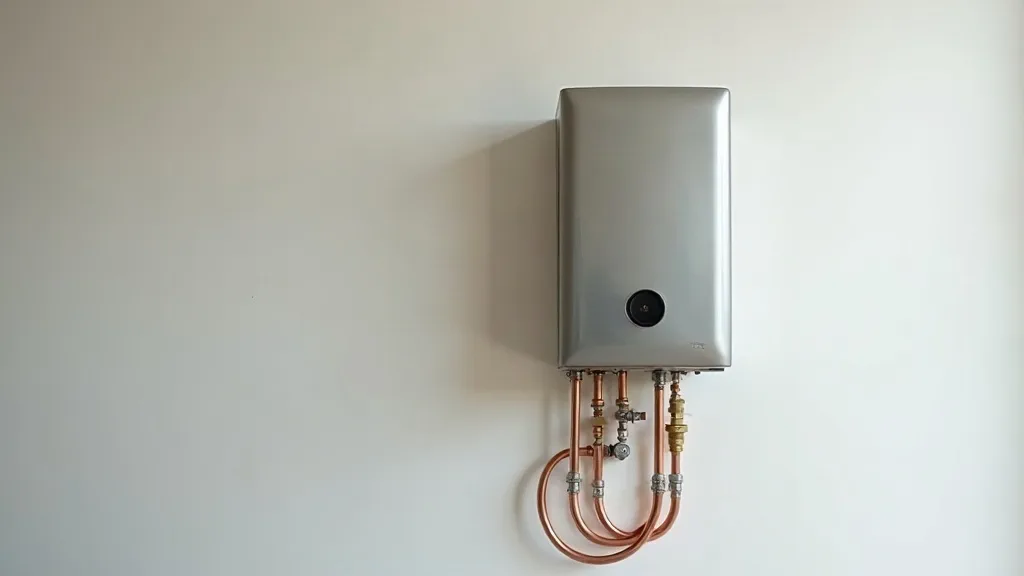
A tankless water heater has no tank. Water passes through a heat exchanger, the burner or the elements fire, and hot water comes out the other side for as long as you keep the tap open. That is the whole idea, and it is genuinely good.
What it is not is a cheaper way to heat water. The energy saving is real and small; the installation is real and large. Almost every argument you will read about tankless water heaters online is an energy argument, and almost every disappointment is an installation or a sizing one.
So this page is about the installation and the sizing. And about two claims that are repeated on nearly every tankless page in Charleston and are both wrong here.
The standard tankless page warns you about hard water: minerals bake onto the heat exchanger, efficiency drops, descale it every year or the warranty is void. It is the loudest objection to buying one, and every page in this market repeats it.
Charleston Water System publishes its own hardness. Its FAQ says the water is moderately soft and gives the figure verbatim: “The average hardness level of our water is 58.4 ppm, or 3.4 gpg.” (Charleston Water System FAQ). Its 2025 annual average is lower again, at 54 ppm, or 3.16 grains (Charleston Water System 2025 Water Quality Report).
USGS classifies anything under 60 mg/L as soft (USGS — hardness of water). Charleston is inside that band. York County and Charlotte are further inside it.
Noritz sets its threshold in its own owner’s guide: “If the water supply is in excess of 12 gpg (200 mg/L) of hardness, acidic or otherwise impure, treat the water with approved methods in order to ensure full warranty coverage.” (Noritz Owner’s Guide (NRCR/EZ series)). Twelve grains. Charleston runs about a quarter of that threshold, and York County about a sixth.
It does not mean skip the maintenance. Soft water changes how fast scale forms. It does not change what the warranty asks of you. The warranty is a contract and it asks for the flush regardless of what is in your water. What changes here is the interval, and the right move is to make your installer write yours down and to fit isolation valves so the job is 45 minutes and not a teardown.
| Utility | Hardness | Grains per gallon | Source |
|---|---|---|---|
| Charleston Water System | 54–58.4 ppm | 3.16–3.4 gpg | Charleston Water System 2025 Water Quality Report · 2026-05 |
| Mount Pleasant Waterworks | 40–44 ppm | 2.3–2.6 gpg | MPW monthly water quality reports · 2026 |
| Lake Moultrie supply — Summerville CPW, Goose Creek, Moncks Corner | 23 ppm | 1.35 gpg | Summerville CPW 2025 Water Quality Report · 2025 |
| Rock Hill — and Fort Mill, Tega Cay, York | 35 ppm | about 2 gpg | City of Rock Hill Water Quality Report · 2024 data |
| Charlotte Water | 38 ppm | about 2.2 gpg | Charlotte Water — water quality · 2026-08-14 |
Rock Hill and Charlotte publish parts per million and not grains. The grain figures beside them are ours, at 17.1 ppm to the grain. ⚠️ Charleston Water System publishes two hardness figures of its own — 58.4 ppm on the FAQ and 54 ppm as the 2025 average — so the honest way to say it is a range.
Charleston Water System’s own cross-connection manual answers the question directly: “Since 1985, we have installed residential dual check valves on every residential water service to prevent backflow.” (Charleston Water System Cross Connection Control Program Manual EC-CC-00016).
A check valve only lets water travel one way — as the utility puts it, “Residential dual check valves (non-testable devices) installed with each water meter, provide a basic level of system protection against backflow by limiting the flow of water through the water meter to one direction: from the public water system to the Customer.”. Heated water expands, and in a closed system it has nowhere to go, so the pressure climbs every time the heater fires.
That manual runs to 54 pages and never uses the word “thermal” or the word “expansion” once. The utility documents the device and never the consequence.
A relief valve that drips for no apparent reason, usually after a hot shower, and gets replaced twice before anyone fits an expansion tank.
Noritz names the cause in its troubleshooting: a relief valve that discharges periodically may be doing so because of thermal expansion in a closed water system, and it says in as many words not to plug it (Noritz Owner’s Guide (NRCR/EZ series)).
South Carolina adopts the International codes (SC Code §6-9-50 — adoption of nationally recognized codes). The plumbing code section is 607.3: “Where a storage water heater is supplied with cold water that passes through a check valve, pressure reducing valve or backflow preventer, a thermal expansion control device shall be connected to the water heater cold water supply pipe at a point that is downstream of all check valves, pressure reducing valves and backflow preventers.” (SC Plumbing Code (IPC 2021) §607.3, thermal expansion control). The residential code says the same thing about storage water heating equipment (SC Residential Code (IRC 2021) §P2903.4).
Both sections are written around a storage water heater. A tankless unit stores almost nothing, so whether the letter of either section reaches it is genuinely arguable, and it is the building official and the manufacturer’s instructions that settle it on your house. We are not going to tell you the code plainly requires an expansion tank on a tankless unit, because it does not say that, and we are not going to tell you tankless units are exempt, because nothing says that either.
What is not arguable: the check valve is at your meter, not at your heater, so the closed system exists whatever you hang on the wall. Noritz’s installation diagram is captioned “Expansion tank required if a backflow preventer is installed.”. And a tankless unit carries a pressure-only relief valve — “A temperature relief valve is not required” — so the failure you see is a weep, not the dramatic blowoff people expect from a tank.
This is the number that explains every tankless quote you will ever receive. A typical 40-gallon atmospheric gas tank — A.O. Smith’s GCR-40, say — is rated at 40,000 BTU/h (A.O. Smith ProLine atmospheric vent specification sheet). A whole-house condensing tankless unit is rated at about 199,900 BTU/h, about five times the gas demand of the tank it replaces.
The unit has to get that gas on demand, and the manufacturer is explicit that it is the whole house being sized, not the heater: “The gas supply line shall be gas tight, sized, and so installed as to provide a supply of gas sufficient to meet the maximum demand of the heater and all other gas consuming appliances at the location without loss of pressure.” (Rinnai RU199i specification).
Rheem goes one step further and names the meter: “At your gas meter/regulator there will be a rating plate that gives the cubic feet per hour capacity of that equipment. If the total gas required for the system is greater than the rating of the meter/regulator then the local gas company will need to be contacted in order to upgrade the meter/regulator for the system.” (Rheem tankless use & care manual with installation instructions).
| Unit | Gas input, max and min | Connection | Source |
|---|---|---|---|
| Rinnai RU199i | 199,000 BTU/h max, 15,000 BTU/h min | 3/4 in. MNPT | Rinnai RU199i specification · 2026 |
| Navien NPE-240A2 | 199,900 BTU/h max, 13,300 BTU/h min | 3/4 in. NPT | Navien NPE-240A2 specification · 2026 |
| Rheem RTGH-95 | 199,900 BTU/h max, 11,000 BTU/h min | 3/4 in. NPT | Rheem RTGH specification sheet · TK-RTGH rev.1, 10/23 |
| Noritz NRCR111DV | 199,900 BTU/h max, 12,800 BTU/h min | 3/4 in. NPT | Noritz Owner’s Guide (NRCR/EZ series) · rev. 10/25 |
⚠️ This is not the same as “you always need a 3/4 inch line”. Rheem permits half-inch pipe where system pressure is 8.0 inches water column or greater, and Navien permits it subject to the sizing tables and to whether the local jurisdiction approves it. The sizing calculation is the job; the pipe size is its output.
The vent from the tank you are removing is not reusable. A condensing unit exhausts cool, acidic flue gas and produces condensate that has to be drained, so the vent, the termination and the drain are all new work.
Condensing units are Category IV appliances: “This appliance is certified as a Category IV appliance and requires a special venting system. The vent system operates with a positive pressure in the pipe.” (Navien NPE installation manual). Positive pressure means the vent joints are sealed, not slotted together, and the material list is closed — Rheem’s ends with “No other vent material is permitted.” (Rheem tankless use & care manual with installation instructions).
Vent runs are limited, and every bend spends some of the allowance.
| Manufacturer | Max length, 2 in. and 3 in. | Elbow deduction | Source |
|---|---|---|---|
| Rinnai — twin pipe and concentric | 65 ft at 2 in., 150 ft at 3 in. | 90° elbow 6 ft, 45° elbow 3 ft | Rinnai RU199i specification · 2026 |
| Navien | 75 ft at 2 in., 150 ft at 3 in. | at 2 in., 90° elbow 8 ft and 45° elbow 4 ft | Navien NPE installation manual · rev. 2026-01 |
| Rheem | 60 ft at 2 in., 150 ft at 3 in. | 90° elbow 6 ft, 45° elbow 3 ft | Rheem RTGH specification sheet · TK-RTGH rev.1, 10/23 |
A concentric termination costs you five feet of that allowance before you start (Navien NPE installation manual), and Rinnai warns that exhaust and combustion air must never be joined into one pipe with a fitting. Rinnai and Navien both give 12 inches to an openable window or door. Rheem gives four feet below or to the side of an opening and one foot above it.
NOAA’s 1991–2020 climate normal for Charleston International Airport is 24.4 nights a year with a minimum temperature at or below 32°F, 21.5 of them between December and February. (NOAA NCEI 1991–2020 Climate Normals, Charleston Intl. Airport (USW00013880)).
That is an average, not a typical winter. Counting the raw daily record for the same thirty years gives years as mild as seven freezing nights and as hard as fifty-one. An outdoor unit has to survive the fifty-one.
It matters here because outdoor and garage installations are normal in the Lowcountry, and because freeze protection on a gas tankless unit is electric. A unit mounted outside during a power cut in a hard freeze is a unit with no freeze protection.
Ask two questions before you agree to it. What protects it in a freeze, and what happens in a freeze with no power. On a gas tankless unit the answer to the first is usually a set of electric heaters inside the cabinet, which makes the answer to the second uncomfortable.
The cheap insurance is a pair of isolation valves fitted at installation, so the unit can be drained in twenty minutes when a hard freeze is forecast and there is a plan that does not depend on the grid.
ENERGY STAR publishes the number: “By heating water only when you need it, ENERGY STAR certified tankless water heaters save a family of four $95 per year, or $1,800 over its lifetime, on gas bills compared to a standard gas storage model.” (ENERGY STAR — tankless gas water heater benefits and savings).
At $95 a year against a retrofit premium in the thousands, the arithmetic does not close on energy alone, and we are not going to pretend it does. Buy one for the endless hot water and the floor space. The fuel saving is a rounding error next to the install.
The life expectancy is the stronger half of the argument. ENERGY STAR says: “Tankless water heaters have a life expectancy of 20 years, much longer than any conventional tank-type water heater.” The Department of Energy’s guidance put tankless at more than twenty years against ten to fifteen for a tank. ⚠️ That DOE page no longer exists — the whole Energy Saver section was removed from energy.gov around July 2026 and every link into it now returns a 404, including the ones several competitors in this market still publish. The figures above are from U.S. Department of Energy, Energy Saver (archived 30 June 2026 — page since removed).
This one is worth reading twice, because the internet has not caught up with it. The IRS states it plainly: “25C Energy efficient home improvement credit — The credit will not be allowed for any property placed in service after December 31, 2025.” (IRS — FAQs on the termination of §25C and other credits under P.L. 119-21).
The 25C credit was terminated early by P.L. 119-21. National cost guides and a good deal of local marketing still advertise it, and the ENERGY STAR page most of them link to for it now returns a 404.
The rebates in this state are pointed at heat pump water heaters, not tankless ones. Santee Cooper pays $400 for one, and Duke Energy’s programme says in as many words that the rebate is not available on tankless water heaters. If a rebate is what decides your purchase, the honest answer is that you are looking at the wrong appliance. (Santee Cooper — heat pump water heater rebate).
The one piece of tankless-specific money we could find is Dominion Energy South Carolina’s natural gas water heater rebate. Up to $350 for an ENERGY STAR certified natural gas water heater, with tankless units at $250 for UEF 0.80 and $350 for UEF 0.90. ⚠️ Confirm the current amount with Dominion before you count on it — this was read from a copy of the page taken on 1 July 2026 and the amounts change.
Congress disapproved the gas-fired instantaneous water heater standard under the Congressional Review Act, and the Department of Energy withdrew it on 20 May 2025. (Federal Register — withdrawal of the gas-fired instantaneous water heater standard). The separate consumer water heater standard stands, and compliance is required on and after 6 May 2029. (Federal Register — consumer water heater energy conservation standards).
Worth saying plainly, because “buy before the rules change” is a live sales line in this trade and there is no 2026 rule behind it.
Then the tankless unit is buying you floor space and about $95 a year. If the tank is eight years old and working, the honest advice is to wait until it fails and make the decision then, when you are not also paying to dispose of a working appliance.
An electric whole-house unit is a genuinely different proposition, and in most Charleston houses it is a panel job before it is a plumbing job. A 27 kW unit draws 113 amps on its own. Read the gas-versus-electric page before anyone quotes you one.
The saving is real and it is small, and on a retrofit with a new gas line and a new vent it does not pay the premium back inside the life of the unit. Buy it for the endless hot water. That part is true.
Those three lines are most of the difference between a $3,000 job and a $6,000 one. A single number with no scope behind it cannot be compared with another single number, and that is where change-order arguments start.
It is worth it if you are chronically running out of hot water, want the floor space back, or are already opening up the wall for other work. It is a poor fit if your tank is healthy and the retrofit needs a new gas line and new venting.
Buy it for endless hot water and for the twenty-year life expectancy. Do not buy it for the fuel saving — ENERGY STAR puts that at $95 a year for a family of four against a standard gas tank, which will not repay a retrofit premium of several thousand dollars inside the life of the unit.
Charleston does not have hard water, and this is the single most common mistake made about tankless units here. Charleston Water System publishes its own hardness at about 54 to 58 ppm — roughly 3.2 to 3.4 grains — and calls the supply moderately soft. USGS classifies anything under 60 mg/L as soft.
Noritz sets its warranty threshold at 12 grains per gallon; Charleston runs about a quarter of that and York County about a sixth. That lowers the rate at which scale forms. It does not remove the manufacturer’s maintenance condition, so ask your installer to write your service interval down rather than assuming either the annual schedule or no schedule at all.
Probably, and the reason is specific to this city. Charleston Water System has fitted a dual check valve to every residential water service since 1985, which makes your house a closed system — heated water expands and has nowhere to go.
Be careful how this is stated. The plumbing code section on thermal expansion is written around a storage water heater, so whether its letter reaches a tankless unit is genuinely arguable and it is your building official and the manufacturer’s instructions that settle it. What is not arguable is that Noritz’s own installation diagram is captioned “Expansion tank required if a backflow preventer is installed”, and that the classic symptom — a relief valve that weeps after a hot shower — gets misdiagnosed as a faulty valve and replaced twice before anyone fits the tank.
Because a whole-house gas tankless unit burns about five times the gas of the tank it replaces — roughly 199,900 BTU per hour against 40,000 — so the gas supply, the vent and the condensate drain are usually all new work.
The manufacturers are explicit that the sizing covers the whole house and not just the heater, and Rheem tells installers to check the meter’s own capacity rating and call the gas company if the total demand exceeds it. Published local prices reflect it: $2,850 to $4,500 for a new gas installation, but $1,950 to $3,800 to replace an existing tankless, where the gas line and the vent already exist.
There is no federal tax credit for a water heater installed in 2026. The IRS states that the Energy Efficient Home Improvement Credit “will not be allowed for any property placed in service after December 31, 2025”.
Plenty of cost guides and local marketing still advertise the 30% credit, and the ENERGY STAR page most of them link to for it now returns a 404. The one tankless-specific programme we found is Dominion Energy South Carolina’s natural gas water heater rebate, at $250 to $350 depending on efficiency — confirm the current amount with Dominion directly. The larger South Carolina rebates are pointed at heat pump water heaters, and Duke Energy’s says in as many words that it is not available on tankless units.
Yes, and outdoor and garage installations are common enough here to make it a real question. NOAA’s 1991–2020 normal for Charleston is 24.4 nights a year at or below freezing.
The average understates the risk. Counting the raw thirty-year daily record gives years as mild as seven freezing nights and as hard as fifty-one, and an outdoor unit has to survive the fifty-one. Freeze protection on a gas tankless unit is electric, so ask what happens during a power cut in a hard freeze, and have isolation valves fitted so the unit can be drained when one is forecast.
The licensed plumbing subcontractor, in their own name. We contract the job and schedule the inspections.
A gas conversion generally needs both a plumbing permit and a fuel gas permit. In the City of Charleston that is a $40 application fee on each, plus the per-fixture and per-outlet charges; North Charleston is the only jurisdiction in either metro whose published fee schedule has a water heater line on it at all. The permit is never the expensive part — the inspection is what protects you if the unit fails and an insurer asks who fitted it.
Charleston, Mount Pleasant, North Charleston, Summerville, Goose Creek, James Island, West Ashley, Daniel Island, Johns Island, Hanahan, Ladson, Moncks Corner, Isle of Palms, Folly Beach, Park West, Rock Hill, Fort Mill, Tega Cay, Lake Wylie, Clover, York, Indian Land — across the Charleston Lowcountry and York County, South Carolina.
Southeastern Renovation contracts the job as the general contractor. The plumbing and gas work is performed by licensed plumbing subcontractors who pull their own trade permits.
Part of Southeastern Renovation's plumbing division. Charleston's water chemistry is covered in more depth by the water treatment division.