Crawl Space
Crawl Space Encapsulation
Sealing the crawl space, and why the vents were the problem.
Sealing the crawl space, and why the vents were the problem.
Quick answer: Crawl Space Encapsulation. Southeastern Renovation is a licensed South Carolina general contractor (CLG.127339) serving the Charleston Lowcountry and York County, SC. Work is coordinated by Southeastern Renovation as the general contractor. Licensed trade subcontractors handle work requiring their trade credentials; permit responsibilities depend on the project scope and jurisdiction. Call (843) 718-8177 for an estimate.
The physics are simple once stated. Warm, humid outside air enters a vented crawl space and meets surfaces that are cooler than it is — ducts, joists, the ground. Air that is cooled below its dew point releases water, so on the most humid days of the year the vents are actively delivering moisture to the wood. That is why the space is wettest in summer, not in winter.
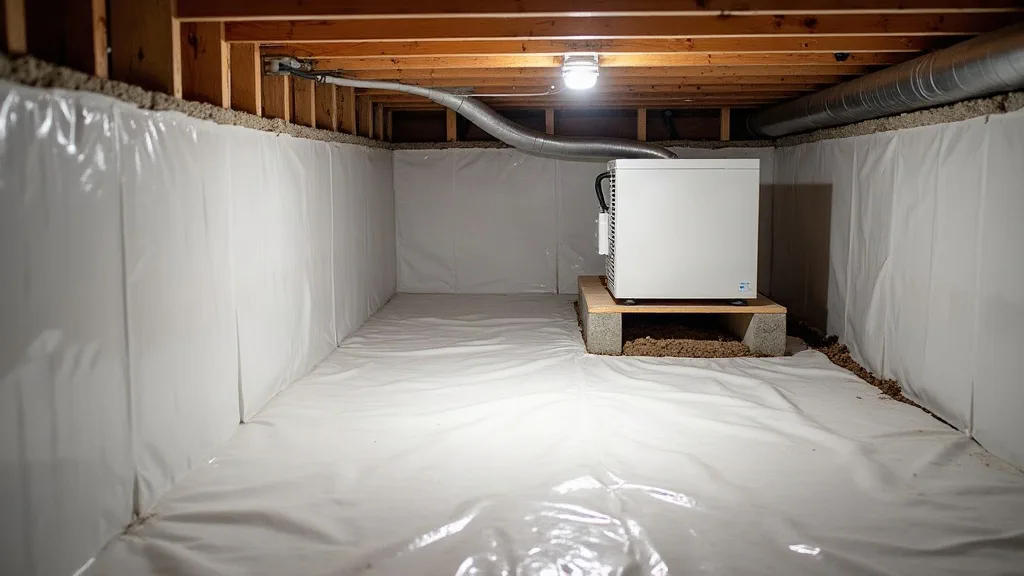
Encapsulation closes that loop: seal the vents, line the ground and walls with a heavy vapour barrier, seal the seams, and control the remaining humidity with a dehumidifier sized for the volume. The space becomes a semi-conditioned part of the house rather than an opening to the outside.
The order matters and gets skipped. Any standing water or drainage problem is fixed before the liner goes down, because sealing a barrier over a wet crawl space traps the water under plastic instead of removing it.
Serving Charleston, Mount Pleasant, North Charleston, Summerville, Goose Creek, James Island, West Ashley, Isle of Palms, Moncks Corner, Hanahan, Ladson, Daniel Island, Johns Island, Park West, Seabrook Island, Kiawah Island, Edisto Island, Folly Beach, Ravenel, Rock Hill, Fort Mill, Tega Cay, Lake Wylie, Clover, York, Indian Land across the Charleston Lowcountry. Part of Southeastern Renovation.
The reasoning behind them does not hold in this climate. Vents were meant to dry the space; here they admit humid air that condenses on cooler surfaces underneath the house, which is why a vented crawl space is at its wettest in the middle of summer.
In this climate, effectively yes. Sealing the space stops new moisture arriving, but it does not remove what is already there or what migrates in, and a dehumidifier sized for the volume is what holds the humidity down afterwards.
Any standing water or drainage issue gets solved first. A vapour barrier laid over a wet crawl space seals the water in rather than dealing with it.