Cabinets & Countertops
Custom Range Hoods in Charleston & York County, SC
Built to match your cabinets, sized to your cooktop, ducted to the outside.
Built to match your cabinets, sized to your cooktop, ducted to the outside.
Home › Cabinets & Countertops › Custom Range Hoods
Quick answer: Southeastern Renovation designs and installs custom range hoods: a wood hood surround built to order, painted to match your cabinets and tied into the crown, around a ducted hood insert sized to your cooktop. We work across the Charleston area and York County, SC, as a licensed South Carolina general contractor (CLG.127339). Call (843) 718-8177 for an estimate.
A custom range hood is the cabinetry-matched surround you see over the cooktop, built around a manufacturer’s hood insert that does the venting. The insert holds the fan, lights and grease filters. You buy it with your appliances; we confirm the model fits before you order it, then build the surround around it.
Because the surround is part of the cabinet job, we paint it with the same color as your cabinets and run it into the crown molding. Done that way it reads as part of the kitchen, not an appliance hung on the wall.
Three routes: a custom surround around an insert, a finished chimney-style hood, or a plain under-cabinet hood. An insert (also sold as a liner or power pack) is built to disappear inside a surround, so it only makes sense with one. If you skip the custom surround, buy a finished chimney-style or wall-mount hood instead of an insert. Under-cabinet hoods are the budget choice and sit under a short wall cabinet.
Five shapes, four details, three finishes. Tap a shape and a detail to see it drawn on a cooking wall, then copy your choice into your estimate request. We size the height to your ceiling and the width to your cooktop.
Upgrade details are priced separately. Ask us for the number before you decide.
Standard. Same color as your cabinets.
Curved · Plain · Painted to match the cabinets
Copy it into the notes of your estimate request, or read it to us on the phone.
Drawings show style only. Final dimensions are confirmed on site.
Size the insert to the cooktop, and stay at or under 400 CFM unless you plan for make-up air. For a typical 30-inch gas cooktop we specify a 36-inch ducted insert at 400 CFM or less, which clears a normal home kitchen well. A common rule of thumb for gas is about 100 CFM for every 10,000 BTU of total burner output, so a large pro-style range can justify more, and more airflow brings the make-up air requirement below.
Ducted inserts beat recirculating (“ductless”) ones: a recirculating hood filters grease and returns the heat and moisture to the room. We build for ducted inserts.
When it can exhaust more than 400 cubic feet per minute. South Carolina’s modification to section M1503.6 of the International Residential Code requires make-up air at roughly the rate the hood exhausts above 400 CFM. The make-up air system needs at least one damper, either gravity-operated or electrically operated so that it opens automatically when the hood runs, and the damper must be reachable for service without tearing out finished work.
In a tight, modern house a powerful hood without make-up air pulls air from wherever it can, including back down a fireplace flue or a water heater vent. That is the reason for the rule, and it is why we size the insert before we design the hood.
South Carolina currently enforces the 2021 IRC with state modifications; the Building Codes Council has adopted the 2024 edition for local enforcement from January 1, 2027. Your permit office has the final word on which edition applies to your job. Sources: SC Building Codes Council 2021 modification index; 2021 IRC chapter 15, exhaust systems.
Through a smooth, airtight metal duct to a wall or roof cap with a backdraft damper, never into an attic, crawl space or wall cavity. The duct size comes from the insert’s installation manual. The shortest run with the fewest elbows moves the most air and makes the least noise, so we pick the route first and let it decide where the hood can sit.
The insert’s installation manual sets the mounting height, and it overrides any rule of thumb. Many manufacturers call for roughly 24 to 30 inches above the cooking surface. For width, the hood should cover the cooktop with a little to spare on each side; that is why a 30-inch cooktop gets a 36-inch insert.
The outside end of the duct. Salt air is hard on exterior metal, and wind-driven rain finds any gap. On island and waterfront houses we specify a corrosion-resistant wall or roof cap with a damper that closes fully, and seal the penetration as carefully as a window. Check the cap once a year; a damper stuck open lets in humid air and insects, and one stuck shut starves the fan.
Order it in the first week of the job. On a recent Charleston kitchen the hood took about five weeks to build and deliver, and it has to be on the wall before the backsplash goes up. Pick the shape, detail and finish early, and get us the insert model at the same time.
Southeastern Renovation coordinates the whole hood as the general contractor. Licensed trade subcontractors handle work requiring their trade credentials, such as the electrical for the insert; permit responsibilities depend on the project scope and jurisdiction. Gas cooktops and ranges are connected and checked by a qualified gas fitter.
It is priced per kitchen, in your written estimate. What moves the number: the shape and size, the ceiling height, the detail (plain, strapping, shiplap or brass), paint versus stain, the duct route and whether make-up air is needed. A plain hood painted to match the cabinets is the standard; we price upgrades separately so you can see each one.
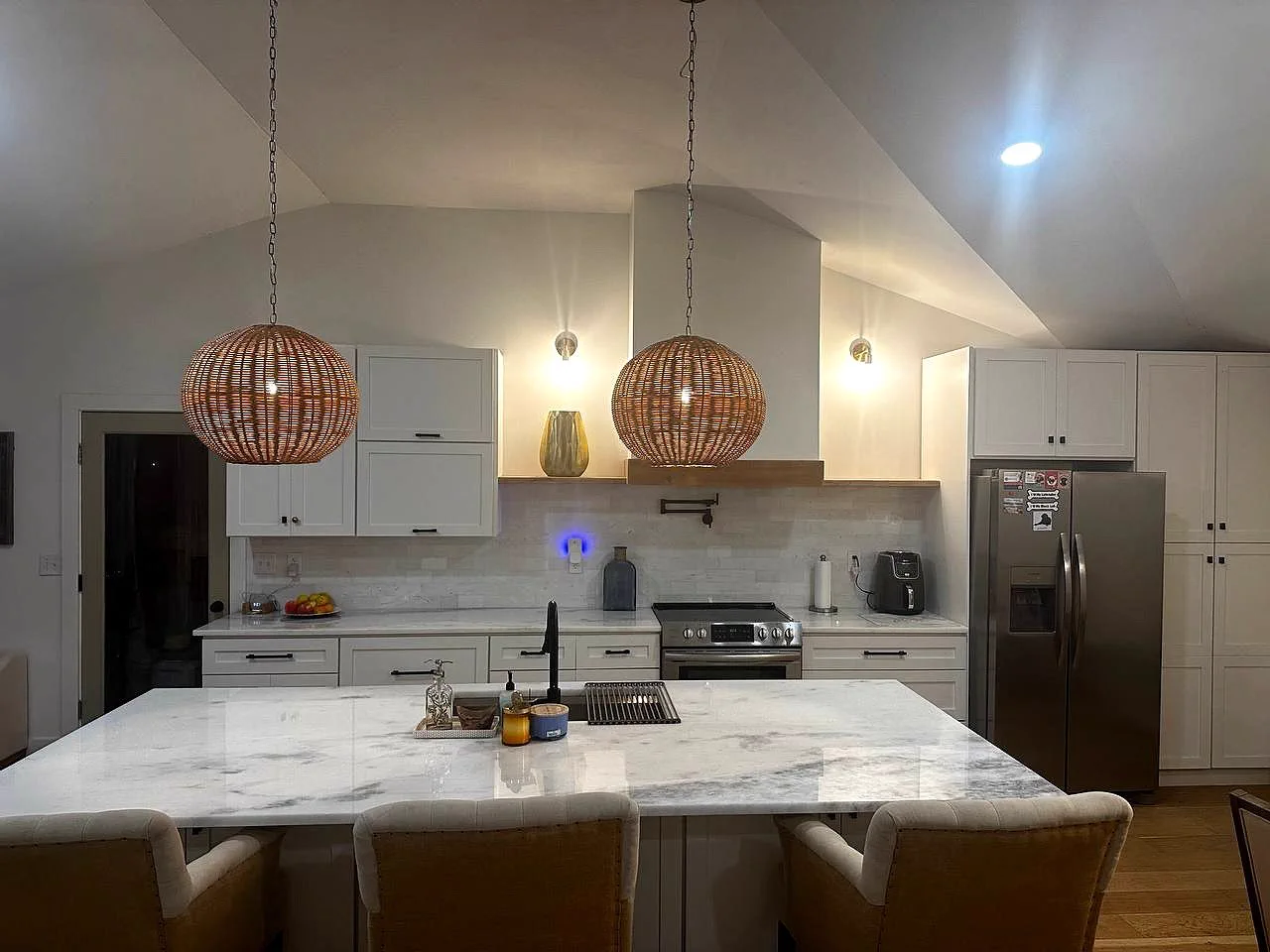
Real job photos from Charleston-area kitchens, some finished and some mid-job.
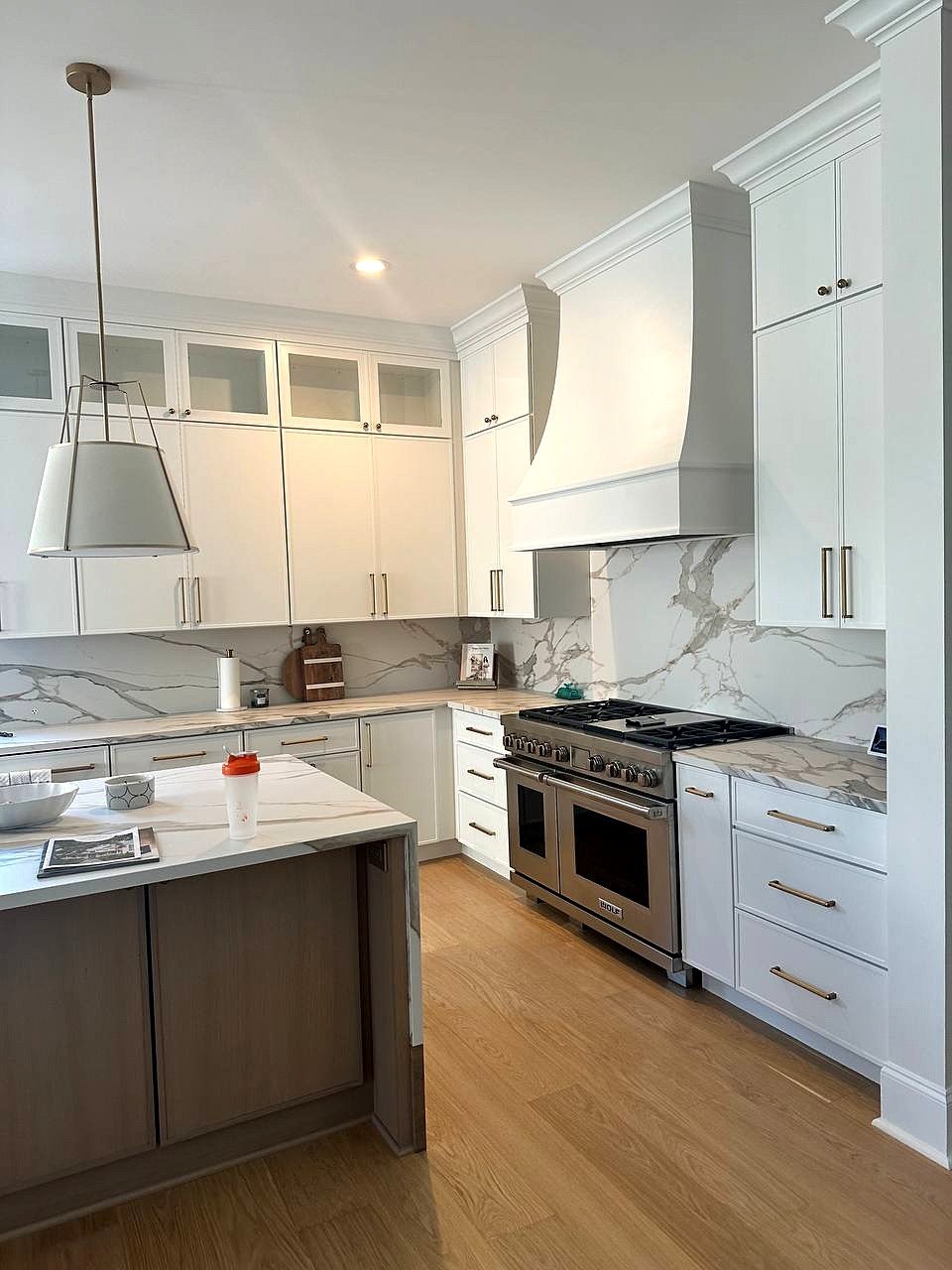
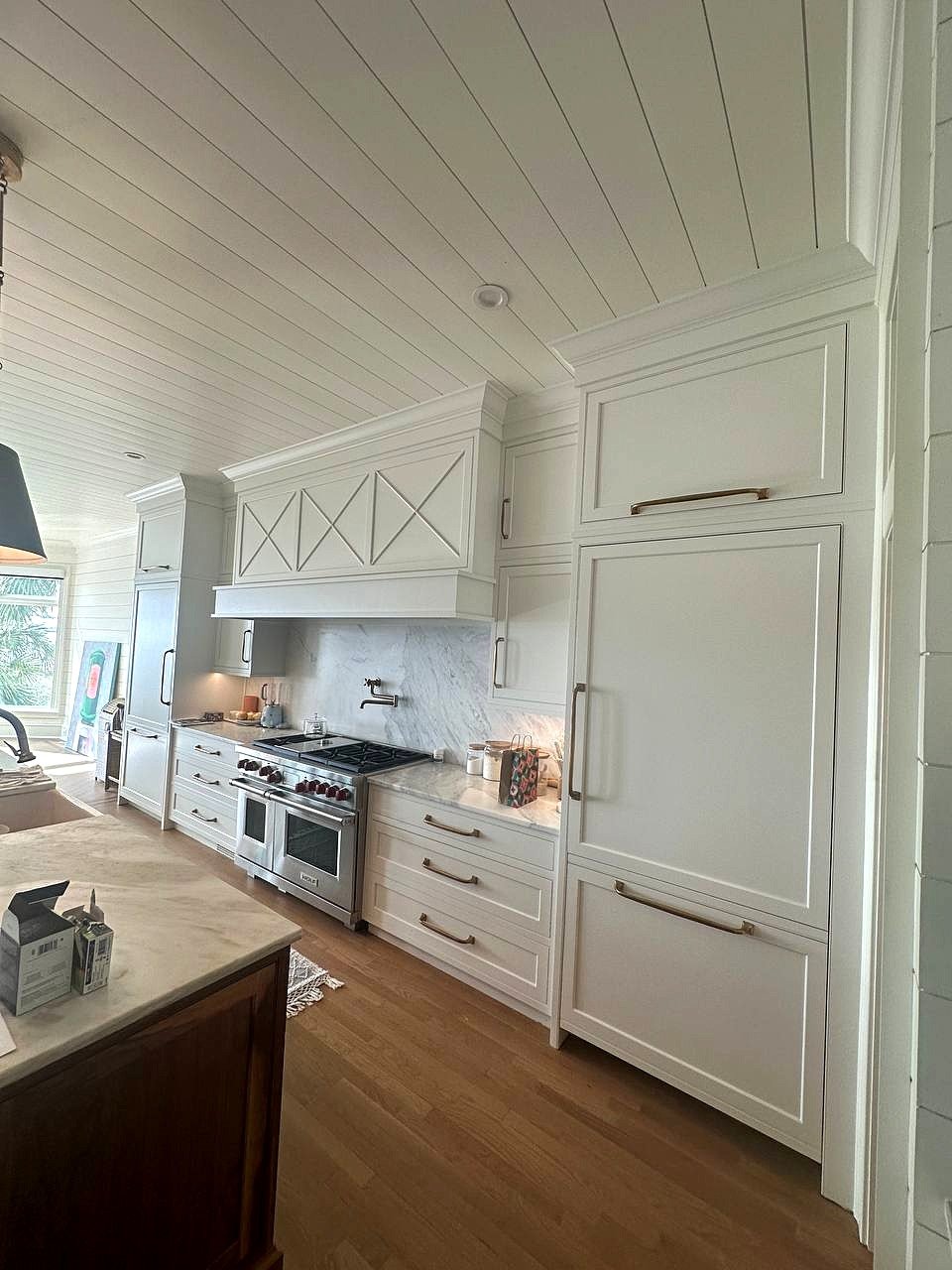
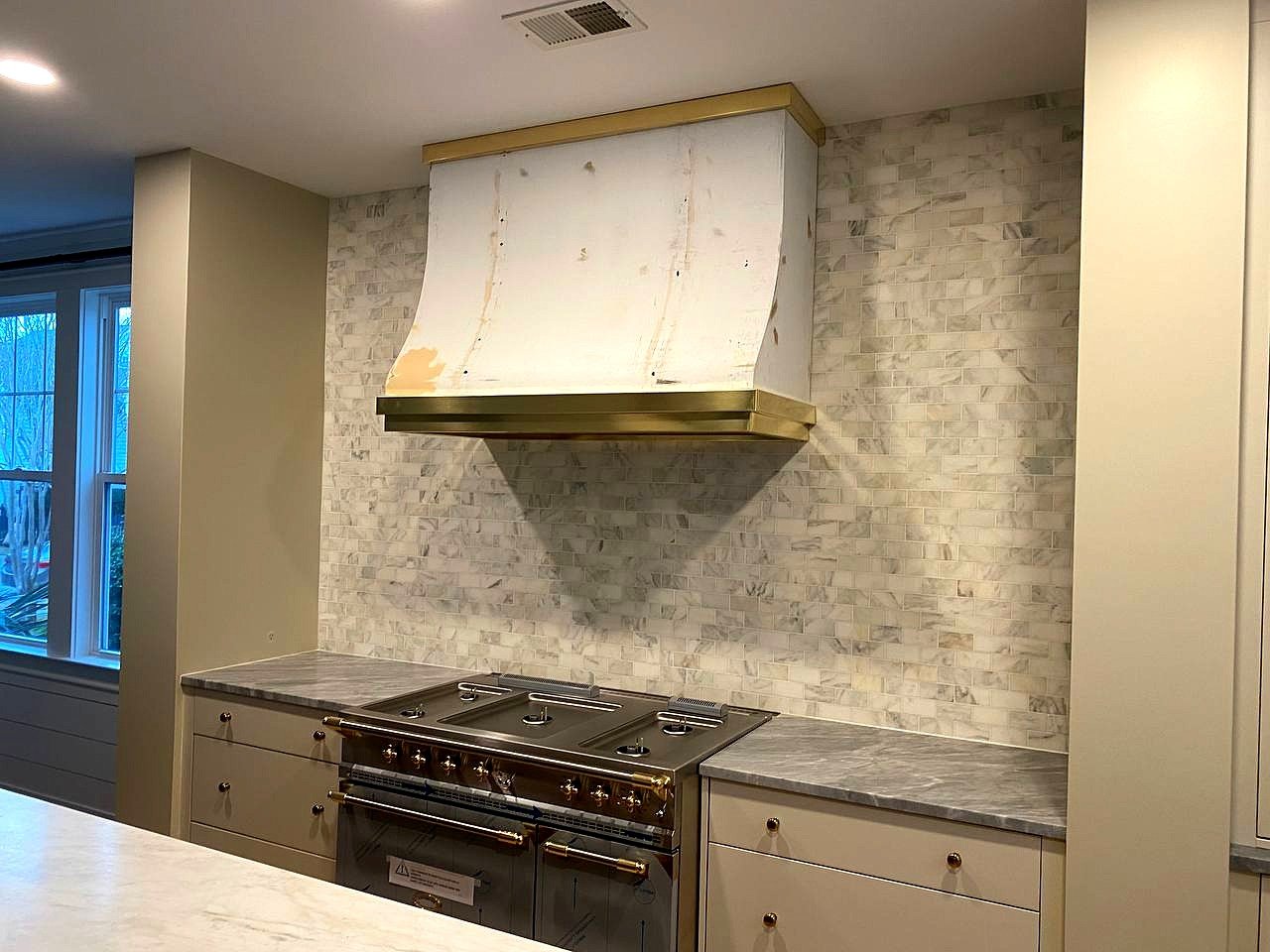
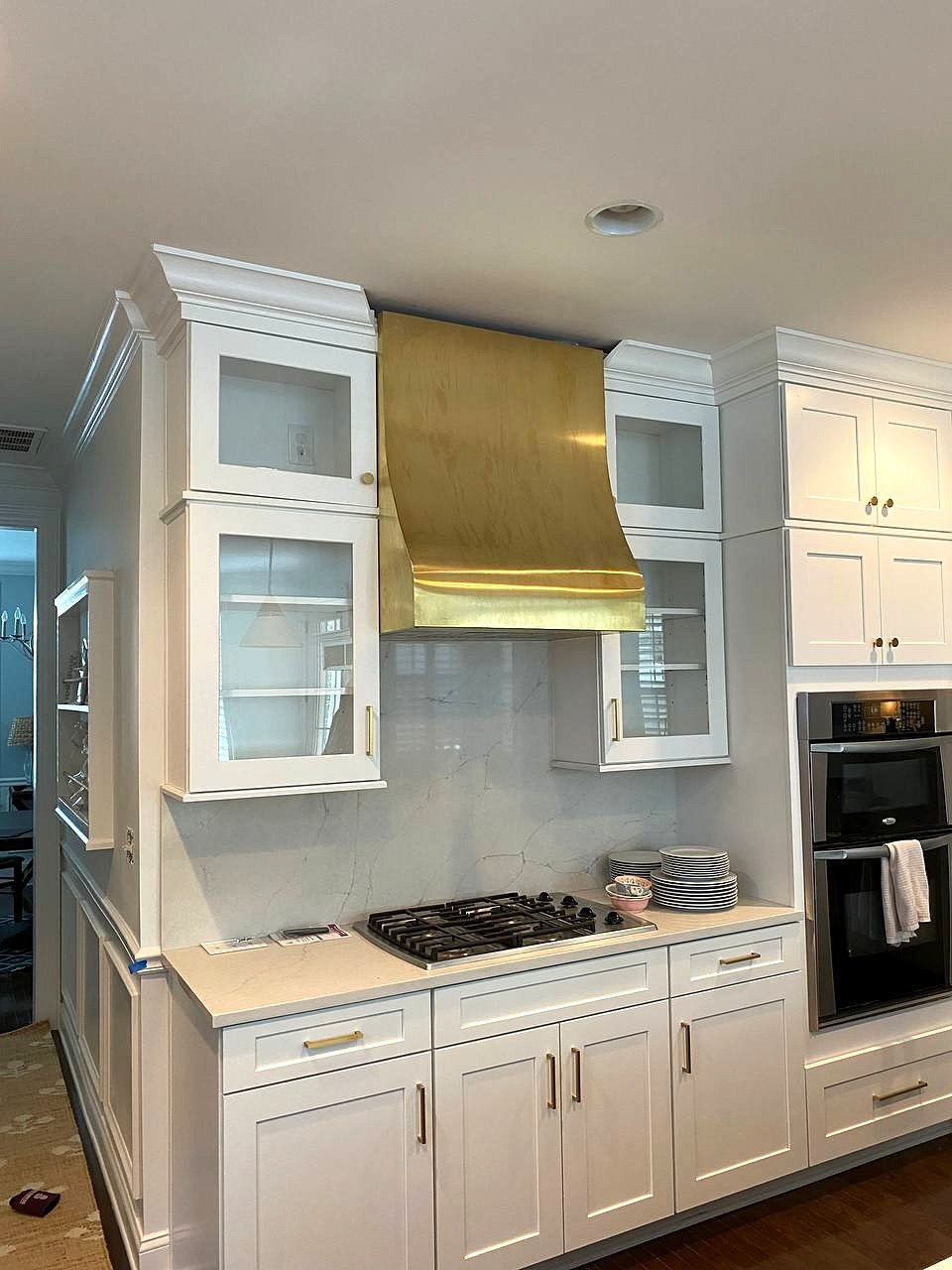
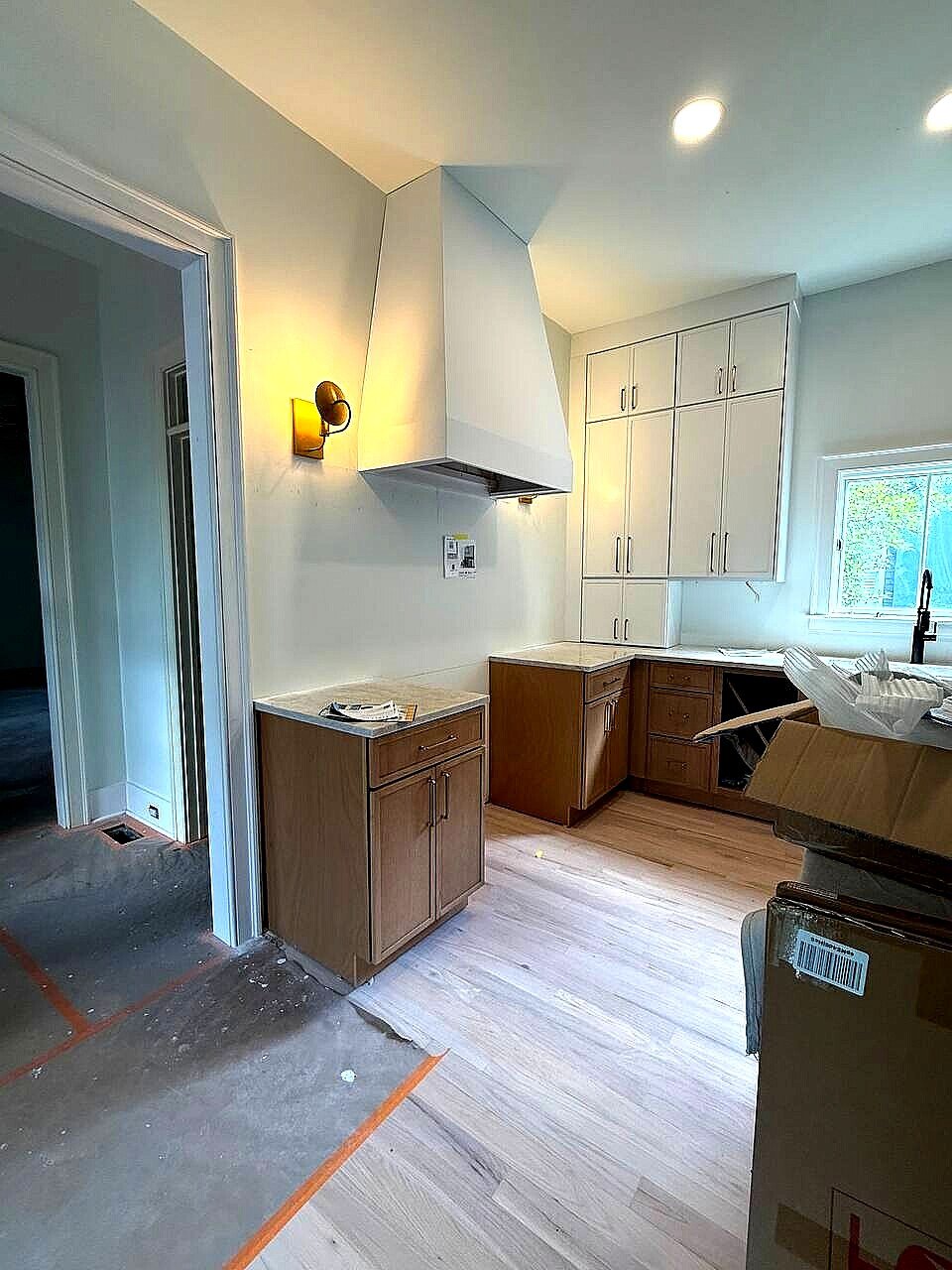
A custom range hood is a decorative surround, usually wood, built to match your cabinets and fitted around a manufacturer’s hood insert.
The insert is the working part: the fan, lights and grease filters. The surround is what you see. We build it to order, paint it the same color as your cabinets and tie it into the crown molding so it reads as part of the cabinetry.
Size the insert to the cooktop, not to the biggest number on the box.
For a typical 30-inch gas cooktop we specify a 36-inch ducted insert at 400 CFM or less. A common rule of thumb for gas is about 100 CFM for every 10,000 BTU of total burner output; a large pro-style range can exceed 400 CFM, and above 400 CFM South Carolina’s code requires make-up air.
When the hood can exhaust more than 400 cubic feet per minute.
South Carolina’s modification to IRC section M1503.6 requires make-up air at roughly the rate the hood exhausts above 400 CFM, with at least one damper that is gravity-operated or opens automatically when the hood runs, and that damper must be accessible for service. Staying at or under 400 CFM avoids the requirement.
No. A kitchen hood must discharge outdoors, not into an attic, crawl space or wall cavity.
The residential code expects a smooth-walled, airtight metal duct ending at a wall or roof cap with a backdraft damper. We plan the duct route before the hood is built, because the route decides where the hood can sit.
The insert’s installation manual sets the height, and it overrides any rule of thumb.
Many manufacturers call for roughly 24 to 30 inches above the cooking surface. We size the hood’s height to your ceiling and its width to your cooktop, usually a few inches wider than the cooktop on each side.
Five shapes: curved, tapered, box, sloped and bell.
Each can be plain or detailed with wood strapping, shiplap or brass strapping, and finished painted to match the cabinets, in a contrasting paint color, or stained. A plain, painted hood is standard; the details and a stained finish are upgrades priced separately.
Not well. An insert, also called a liner or power pack, is designed to be hidden inside a surround.
If you do not want a custom surround, buy a finished chimney-style or wall-mount hood instead. If you do want the surround, buy the insert first and send us the model so we can build around it.
Choose it early. On a recent Charleston kitchen the hood took about five weeks to build and deliver.
We need your shape, detail and finish, plus the insert model number, in the first week of the job so the hood is on the wall before the backsplash goes up.
Yes. We plan and install custom range hoods in Rock Hill, Fort Mill, Tega Cay, Lake Wylie, Clover, York and Indian Land as well as across the Charleston area.
The same shapes, details and finishes are available in both markets.
The hood is usually one part of a cabinet or kitchen project. Browse cabinet collections and colors, read how we price kitchen cabinets, compare cabinet refacing, or see the full kitchen remodeling process.
Serving Charleston, Mount Pleasant, North Charleston, Summerville, Goose Creek, James Island, West Ashley, Isle of Palms, Moncks Corner, Hanahan, Ladson, Daniel Island, Johns Island, Park West, Seabrook Island, Kiawah Island, Edisto Island, Folly Beach, Ravenel, Rock Hill, Fort Mill, Tega Cay, Lake Wylie, Clover, York, Indian Land. Part of Southeastern Renovation Cabinets & Countertops.