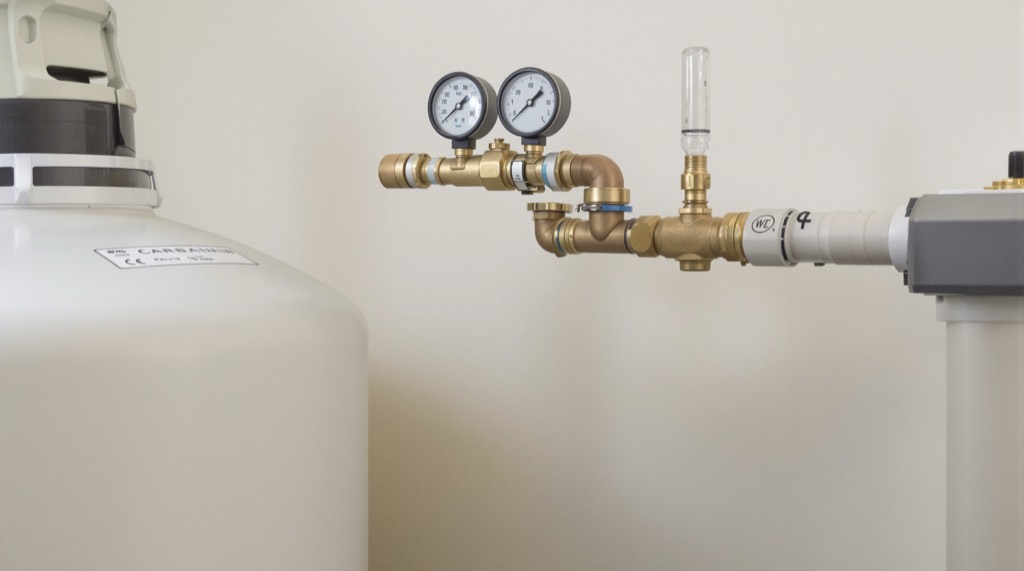
Point of entry
Whole-House Water Filtration
Sized for the disinfectant actually in your water — not for the box on the shelf.
Sized for the disinfectant actually in your water — not for the box on the shelf.
Quick answer: A whole-house filter treats every tap, shower and appliance in the house from a single point on the main line. In Charleston it has one job worth paying for — removing chloramine, taste, odour and disinfection byproducts — and doing that properly needs catalytic carbon and enough of it. It will not reliably remove PFAS, and we do not sell it as if it will. Southeastern Renovation is a licensed South Carolina general contractor (CLG.127339); the plumbing tie-in is performed by a licensed plumbing subcontractor who pulls the permit. Call (843) 718-8177.
A whole-house filter — point of entry, in the trade — goes on the cold main after the meter and before the water heater, so everything downstream of it gets treated water. That is its advantage over an under-sink filter: the shower, the washing machine and the water heater see it too.
It is also where most of the money in this industry gets spent badly, because the thing that decides whether a whole-house filter works is not the brand on the tank. It is how long your water stays inside the carbon. That number has a name — empty bed contact time — and it is published, and almost nobody selling these systems in Charleston will do the arithmetic in front of you.
We will. It is on this page.
Charleston Water System does not disinfect with plain chlorine. In its own words: “We use chlorine dioxide and chloramines (a compound formed by combining ammonia and chlorine) to protect against harmful microorganisms.” (Charleston Water System FAQ).
Chloramine is more stable than free chlorine. That is exactly why utilities like it — it survives the journey to your house. It is also why it is harder to take back out.
Standard granular activated carbon needs about ten minutes of contact time to deal with chloramine. Catalytic carbon — carbon whose surface has been modified for exactly this — needs three to four.
The technical literature is blunt about it: “To compensate for poor performance of traditional GAC for monochloramine removal, manufacturers have developed surface-enhanced activated carbons. Based upon field studies for surface enhanced GAC, a minimum EBCT of 3 minutes is recommended. For traditional GAC, a minimum EBCT of 10 minutes is recommended.” (Potwora, “Chlorine and Chloramine Removal with Activated Carbon”, Water Conditioning & Purification).
| What you are removing | Contact time needed | Source |
|---|---|---|
| Free chlorine, standard carbon | 1–2 minutes | Battenberg, “The Activated Carbon Filtration Contactor”, WC&P · 2018-06-15 |
| Chloramine, standard carbon | 10 minutes minimum | Potwora, “Chlorine and Chloramine Removal with Activated Carbon”, Water Conditioning & Purification · 2009-06-13 |
| Chloramine, catalytic carbon | 3–4 minutes minimum | Potwora, “Chlorine and Chloramine Removal with Activated Carbon”, Water Conditioning & Purification · 2009-06-13 |
| Disinfection byproducts, standard carbon | about 7 minutes | Battenberg, “The Activated Carbon Filtration Contactor”, WC&P · 2018-06-15 |
The formula is not a secret. Contact time in minutes = carbon volume in cubic feet × 7.48 ÷ flow rate in gallons per minute.
So the question for any system you are quoted is simply: how many cubic feet of carbon, and at what flow rate? Here is what it takes to reach a four-minute contact time with catalytic carbon.
A 1.5 cubic foot “whole house catalytic carbon” system on a three-bathroom house flowing 9 to 12 gallons a minute delivers roughly one minute of contact time — a quarter to a third of what the published minimum requires.
That is not a small miss. It is the difference between a filter that does the job and a filter that mostly just costs money and needs its media replaced on schedule.
| Flow rate | Catalytic carbon required | |
|---|---|---|
| 5 gpm | 2.7 cubic feet | |
| 8 gpm | 4.3 cubic feet | |
| 10 gpm | 5.3 cubic feet | |
| 12 gpm | 6.4 cubic feet |
Those are the carbon volumes needed to reach a four-minute contact time with catalytic carbon. To reach ten minutes with ordinary carbon at 8 gpm you would need about 10.7 cubic feet, which is not a residential tank. That is precisely why catalytic carbon exists. These volumes are our own calculation using the formula published by Potwora, “Chlorine and Chloramine Removal with Activated Carbon”, Water Conditioning & Purification — the formula is theirs, the arithmetic is ours, and you can check it.
There is no point-of-entry system on the market with an NSF certification for PFAS reduction. We checked NSF's own certified-product database: 49 products are certified for total PFAS reduction and 60 for PFOA, and every one of them is point-of-use (NSF certified drinking water treatment units database).
Worse, when Duke and NC State tested real homes, PFAS levels rose after filtration in four of the six whole-house carbon systems they measured (Duke / NC State home filter study (Herkert et al., ES&T Letters)). Loaded carbon can release short-chain compounds back into the water. If PFAS is your concern — and in Charleston it reasonably is — the answer is at the kitchen sink, and it costs a fraction of this.
Carbon does not remove hardness. It also does not need to here — every public supply in both of our markets is soft, by the utilities' own published figures.
That is the point, and it has a consequence worth knowing. The Duke and NC State researchers noted it directly: because these systems remove the disinfectant the utility put in, they can leave household pipes more hospitable to bacterial growth (Duke / NC State home filter study (Herkert et al., ES&T Letters)).
It is a manageable trade, not a reason to avoid one. It is a reason to size it properly, service it on schedule, and not install one in a house that sits empty for months.
Everything goes on the cold main, upstream of the water heater. That is not a preference — the equipment says so. Filter housings are rated to about 100°F, softener control valves to 110°F, and hot water backing up into any of it destroys them.
It needs a bypass so the house still has water when the system is being serviced, and a drain for anything that backwashes. In this climate it also needs to be somewhere it will not freeze: one major manufacturer permits outdoor installation only in climates that do not reach freezing, and Charleston reaches freezing roughly two dozen nights a year. Garage or conditioned space, in practice.
If chlorine taste and smell bother you, or you want the shower and the appliances treated rather than just the kitchen tap, yes — that is what it is genuinely good for.
If your concern is PFAS, no — buy an under-sink reverse osmosis system instead, because no whole-house system carries a PFAS certification and the field evidence on them is poor. And if somebody is selling you one for hard water, Charleston Water System's own published figure is 58.4 ppm, which the utility itself calls moderately soft.
Catalytic carbon has a modified surface that deals with chloramine far faster — three to four minutes of contact time against about ten for ordinary carbon.
Because Charleston Water System uses chloramine rather than free chlorine, ordinary carbon in a residential-sized tank does not get enough contact time to do the job. This is the single most common way a whole-house system in this market is specified wrongly.
Big enough that your water spends three to four minutes inside the carbon at the flow rate your house actually runs at.
At 8 gallons per minute that is about 4.3 cubic feet of catalytic carbon; at 10 gallons per minute, about 5.3. A 1.5 cubic foot tank on a three-bathroom house delivers roughly one minute. Ask any contractor for the cubic feet and the design flow rate, and do the arithmetic.
Not reliably, and we will not sell you one on that basis.
No point-of-entry system carries an NSF certification for PFAS reduction. In a study of real homes by Duke and NC State, PFAS levels actually increased after filtration in four of the six whole-house carbon systems tested. Point-of-use reverse osmosis removed 94% or more.
Equipment runs roughly $1,100 to $3,500 depending on whether it is standard or catalytic carbon and how big the tank is, and installed prices in national cost guides run about $600 to $2,000 on top.
We publish the sourced ranges for both our markets: Charleston prices and York County prices. Those are published market ranges, not our quote — call and we will price your house.
It depends on the manufacturer, and the published figures genuinely disagree.
Two major manufacturers rate their media at 1,000,000 gallons or ten years. National cost guides put a tank bed at three to five years and $150 to $400. Both are sourced and both are in circulation, so ask for the specific figure for the specific system you are being quoted, in writing.
Part of Southeastern Renovation's water treatment division. Published prices: Charleston · York County.