Point of use
Under-Sink Reverse Osmosis
The small box that actually solves the big problem.
The small box that actually solves the big problem.
Quick answer: Under-sink reverse osmosis pushes water through a membrane fine enough to strip out what carbon cannot — PFAS, nitrate, arsenic, fluoride and lead among them. In the Charleston metro, where every surface-water system tested above EPA’s new PFAS limit, this is the piece of equipment that actually addresses it, and it is far cheaper than a whole-house system. Installed prices in national cost guides run about $300 to $950. Call (843) 718-8177.
Reverse osmosis works by pressure, not adsorption. Water is pushed against a semipermeable membrane; most of what is dissolved in it does not get through and goes down the drain instead. That is a fundamentally different mechanism from a carbon filter, and it is why it catches things carbon misses.
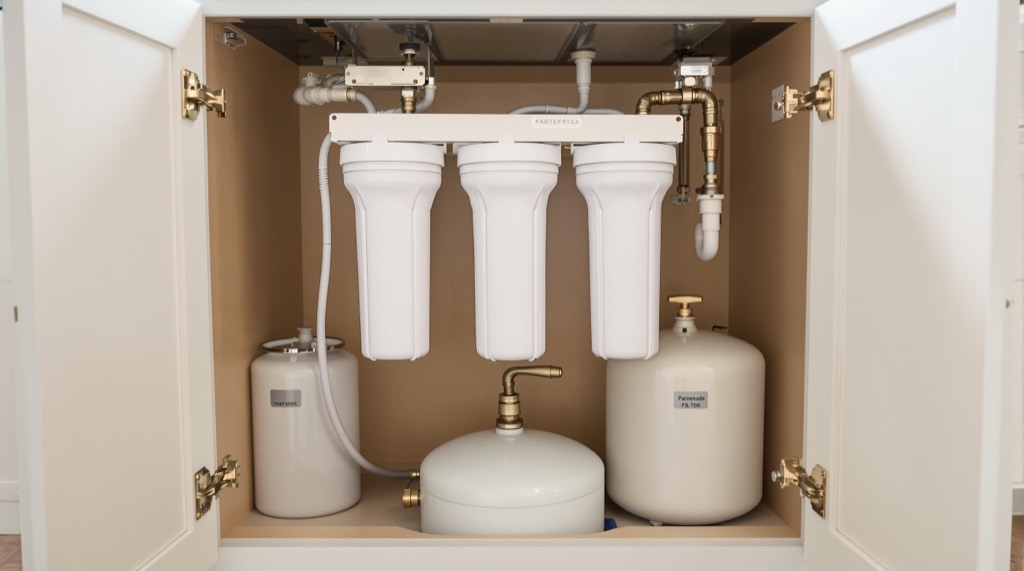
It is a point-of-use system. It treats the water at one tap — normally the kitchen sink, on its own small faucet, and often the refrigerator and ice maker too. That sounds like a limitation and is mostly the opposite: the water you drink and cook with is the water that needs this treatment, and treating only that is what makes it affordable.
EPA's own comparison of treatment technologies puts it plainly: reverse osmosis membranes are typically more than 90% effective across a wide range of PFAS, including the short-chain compounds that carbon struggles with (EPA — reducing PFAS with treatment technologies).
And in the field, in real houses: Duke and NC State tested 76 point-of-use filters and 13 whole-house systems in North Carolina homes. Reverse osmosis and two-stage under-sink filters reduced PFAS, including GenX, by 94% or more. In four of the six whole-house carbon systems tested, PFAS levels actually INCREASED after filtration. (Duke / NC State home filter study (Herkert et al., ES&T Letters))
NSF's certified-product database lists 49 products certified for total PFAS reduction and 60 for PFOA. Every one is point-of-use. There are no point-of-entry products with a PFAS certification at all.
⚠️ Fair caveat: NSF is one of five accredited certifiers, and we did not enumerate the other four. Absence from NSF's directory is not proof a product is uncertified everywhere. But it is a striking absence.
Under NSF/ANSI 58, the standard for reverse osmosis, the only reduction claim a system is required to make is total dissolved solids, at a minimum of 75%. Lead, arsenic, fluoride, nitrate, cysts, PFAS — every one of those is an optional claim the manufacturer chooses whether to certify (NSF/ANSI 58 — reverse osmosis).
So "NSF/ANSI 58 certified" on a box tells you the thing holds pressure, does not leach anything nasty, and takes out some dissolved solids. It does not tell you it takes out PFAS. You have to look up the specific model and the specific claim.
Certifications come in two vintages. The 2021 version of the standard allowed a filter to pass by reducing PFOA and PFOS to 70 parts per trillion. The 2022 version lowered that to 20 ppt total. Many products on sale are still certified to the older, weaker version — and both limits sit above EPA’s new 4.0 ppt standard.
EPA says so itself, on a page still live this year: “The current certification standards for PFAS filters do not yet indicate that a filter will remove PFAS down to the levels EPA has now set for a drinking water standard. EPA is working with standard-setting bodies to update their filter certifications.” (EPA — reducing PFAS with a home filter).
Ask which version of the standard the certification is against. Very few salespeople will know, which is itself informative.
EPA's engineering documentation says a typical point-of-use RO system sends five gallons or more down the drain for every gallon it produces, with typical efficiency ratings between 10% and 20%. The WaterSense label requires at least 30%, which works out around 2.3 gallons wasted per gallon made (EPA WaterSense — POU RO supporting statement).
⚠️ EPA's own consumer-facing page says "about one gallon per gallon", which contradicts its engineering document. We publish the engineering figure, and the honest answer is that it depends entirely on the efficiency rating of the specific unit.
Reverse osmosis demineralises. For a point-of-entry system that matters structurally — EPA notes it can cause lead and copper corrosion inside household plumbing, which is why remineralisation cartridges exist (EPA research — point-of-use and point-of-entry systems).
That is an engineering reason. If anyone tells you remineralised or alkaline water is healthier, that is a different sort of claim and not one we make.
A membrane produces water at its own pace, so most systems store it in a small tank under the sink. Tankless units run a higher-output membrane on demand instead and take up less room. Both work; the tankless ones cost more.
Yes — it is the residential technology with the best evidence behind it, at more than 90% effective across a wide range of PFAS according to EPA, and 94% or better in a field study of real homes.
It is also the only category with NSF certifications for PFAS reduction — all of which are point-of-use systems. Check that the specific model carries the claim, and ask which version of the standard it was certified against.
They do different jobs and are not really competitors.
A whole-house filter handles chlorine, chloramine, taste, odour and byproducts for the entire house — the shower, the laundry, the water heater. Reverse osmosis handles the contaminants that need a membrane, at one tap. In Charleston a lot of houses genuinely want both, and if you can only do one, the under-sink unit addresses the more serious problem for far less money.
Typically five gallons or more down the drain per gallon produced, according to EPA’s own engineering documentation.
Higher-efficiency units do better — EPA’s WaterSense label requires at least 30% efficiency, or about 2.3 gallons wasted per gallon made. Ask for the efficiency rating; it is the number that decides this.
National cost guides put a tanked system at about $300 to $700 installed and a tankless one at $450 to $950.
Equipment alone runs roughly $364 to $1,600 depending on whether it is tanked or tankless and how much output it makes. Sourced ranges are on our Charleston and York County cost pages.
The membrane every two to three years at $50 to $200, and the pre- and post-filters every six to twelve months at $30 to $60.
Annual running cost lands somewhere around $50 to $300 depending on the system. Nothing here is maintenance-free, and a membrane past its life quietly stops doing the thing you bought it for.
You can, but it is rarely the right call in a home.
EPA notes that whole-house reverse osmosis needs a 200 to 500 gallon storage tank, a bladder tank and a pump with a shutoff. Equipment alone starts around $10,000. For the contaminants that need a membrane, treating the drinking tap is the sane answer.
Part of Southeastern Renovation's water treatment division. Published prices: Charleston · York County.