Hardness
Water Softeners — and Whether You Need One
On city water in either of our markets, usually not. Here are the utilities’ own numbers.
On city water in either of our markets, usually not. Here are the utilities’ own numbers.
Quick answer: On public water in Charleston or York County you almost certainly do not need a water softener, and we will tell you so rather than sell you one. Charleston Water System publishes its own hardness as 58.4 ppm (3.4 grains) and calls its water “moderately soft”. Rock Hill, which supplies most of York County, publishes 35 ppm. The USGS soft band is anything under 60. Softeners belong on private wells here, where hardness is genuinely variable. Call (843) 718-8177.
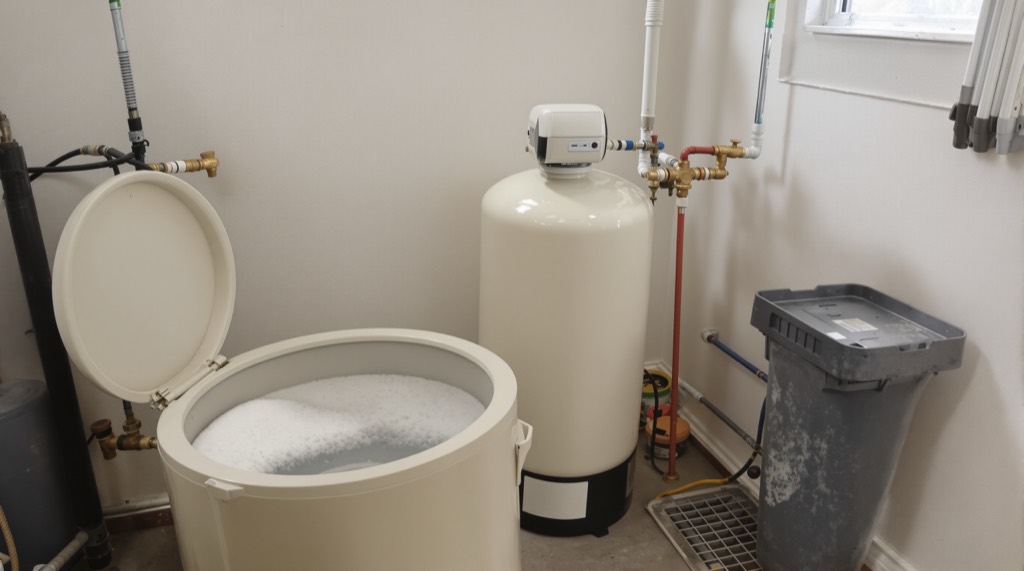
A water softener does one thing: it swaps calcium and magnesium — hardness — for sodium, using a resin bed that regenerates itself with salt. It is very good at that one thing.
It does not remove chlorine or chloramine. It does not remove PFAS; Minnesota’s health department states that flatly, citing its own sampling. It does not remove bacteria or organics, and it handles only modest amounts of iron. Anything you have been told a softener does beyond removing hardness is worth checking.
Which leaves the only question that matters here: how hard is the water?
Every public water supply in the Charleston Lowcountry and York County is inside the USGS “soft” band. York County water is roughly 40% softer than Charleston’s, and Charleston’s is at the top of the soft band rather than outside it.
USGS classifies water under 60 mg/L as soft (USGS — hardness of water). Here is every figure we could source, from the utilities themselves.
| System | Hardness | Source |
|---|---|---|
| Charleston Water System | 58.4 ppm · 3.4 grains | Charleston Water System FAQ · 2026 |
| Charleston Water System (2026 report) | 54 ppm · 3.16 grains | CWS 2026 Water Quality Report · 2026 |
| Mount Pleasant Waterworks | 40–44 ppm · 2.3–2.6 grains | MPW monthly water quality reports · 2026 |
| Lake Moultrie water — Summerville CPW, Goose Creek, Moncks Corner, Berkeley County | 23 ppm · 1.35 grains | Summerville CPW 2025 Water Quality Report · 2025 |
| Rock Hill — and Fort Mill, Tega Cay, York, York County | 35 (range 18–35) ppm · 2.05 grains | Rock Hill 2024 Water Quality Report · 2024 |
| Indian Land — Lancaster County Water & Sewer | 26 ppm · 1.52 grains | Catawba River Water Treatment Plant FAQ · 2026 |
Charleston Water System’s own FAQ puts it in one sentence: “The average hardness level of our water is 58.4 ppm, or 3.4 gpg”, under the heading that its water is moderately soft (Charleston Water System FAQ).
Search for a water softener in Charleston and you will find national sellers building landing pages around figures of 8.5 to 10.2 grains per gallon. The utility publishes 3.4.
That is not a rounding difference or a sampling quirk. It is roughly three times the number, and it is the entire premise on which a softener gets sold in this city.
One large Charleston home-services company publishes an article on hard water shortening appliance lifespans here. Another says the water is very soft at about 25 ppm — right direction, less than half the real figure.
We would rather publish the utility’s number and let you check it.
Private wells. That is the honest short answer, and it is not a small market — more than a third of York County is on a private well, and roughly a fifth of South Carolina.
Well water is not treated by anybody before it reaches you, and hardness varies enormously well to well. It is also the one case where the hardness number is genuinely unknown until somebody tests it. If a softener is going to earn its keep, that is where.
If a well needs a calcite neutraliser for low pH — common in shallow Lowcountry wells, which run acidic — the calcite dissolving into the water adds hardness as a side effect. That can create a genuine softening requirement where none existed before. It is a real sequence, and it is the sort of thing that should be designed as one system rather than sold as two.
If a well needs UV disinfection, the manufacturer sets a ceiling of 7 grains per gallon, above which the water must be softened first or scale fouls the quartz sleeve and the light stops reaching the water (VIQUA UV system owner’s manual 520104_RevAD). That is an engineering requirement, not a sales pitch.
A salt-free conditioner is not a softener and should never be sold as one. NSF/ANSI 44 covers cation exchange only. Salt-free conditioners are outside it entirely — NSF’s own programme director says the standard does not address other scale-reduction technologies.
The only consensus performance standard for these is IAPMO/ANSI Z601, published in 2018, which requires at least a 70% reduction in scale against an untreated control (IAPMO publishes IAPMO/ANSI Z601 scale reduction standard).
The authoritative independent test is an Arizona State University study for the WateReuse Research Foundation, funded by several western water utilities and the California State Water Resources Control Board. It found template-assisted crystallisation reduced scale formation by more than 88%, while electromagnetic and electrically induced devices managed about 50%. (WateReuse Research Foundation / ASU — Evaluation of Alternatives to Domestic Ion Exchange Water Softeners)
But the same study is explicit about what it did not test: “Aesthetic factors such as residue/scale left on fixtures where water evaporates was not addressed, as no credible testing procedures could be identified.” And it notes hardness will still reduce the effectiveness of soap.
It also says the line every buyer should hear first: “There is currently no method for assessing whether a physical water treatment device is working, other than observing scale formation.”
A salt-free conditioner has real, independently measured scale-prevention performance inside a water heater. It does not remove hardness, so spotting, soap scum and the feel of the water are unchanged — and the study that proved the scale benefit deliberately declined to test those. It is not a softener and should never be sold as one.
Soft. Charleston Water System publishes 58.4 ppm, or 3.4 grains per gallon, and describes its own water as moderately soft.
USGS classifies anything under 60 mg/L as soft. CWS’s 2026 report gives 54 mg/L and prints the grains conversion itself. National water-softener retailers advertising Charleston at 8.5 to 10.2 grains are roughly three times over the utility’s own number.
On Charleston Water System supply, almost certainly not — there is very little hardness there to remove.
If you are on a private well, that is a different question entirely and the only way to answer it is a test. We will read your utility’s published report with you before quoting anything, and if the answer is that you do not need a softener, that is what we will tell you.
No — it is softer than Charleston. Rock Hill publishes 35 ppm, about 2 grains, and supplies Fort Mill, Tega Cay, York and much of York County.
Indian Land, on Lancaster County water, is softer still at 26 ppm. Several companies advertise softeners in Rock Hill with copy about saying goodbye to hard water, and none of them publish a number.
No. Minnesota’s health department states it directly, citing its own sampling data: softeners and iron filters do not remove PFAS.
If PFAS is your concern, the technology that addresses it is reverse osmosis at the tap.
A softener removes hardness. A salt-free conditioner does not remove anything — it changes how the minerals behave so they are less likely to form scale.
Independent testing found template-assisted crystallisation reduced scale formation by more than 88% inside a water heater. But it does not reduce hardness, so spotting, soap scum and the feel of the water are unchanged — and the study that measured the scale benefit explicitly declined to test those things.
National cost guides put a single-tank softener at about $1,200 to $3,800 installed, averaging around $2,500, and a dual-tank system at $1,700 to $5,000.
Salt runs $5 to $15 a month and resin lasts ten to fifteen years. Before you spend any of that on city water here, check your utility’s published hardness figure.
Part of Southeastern Renovation's water treatment division. Published prices: Charleston · York County.