Private wells
Well Water Treatment
Nobody treats it, nobody tests it, and nobody tells you when it changes. That is the whole problem.
Nobody treats it, nobody tests it, and nobody tells you when it changes. That is the whole problem.
Quick answer: A private well has no utility behind it: no treatment, no monitoring, and no annual report. Roughly 35% of York County and 16% of Charleston County are on private wells, and testing is optional under South Carolina regulation. The right system depends entirely on a lab test, and the treatment order matters as much as the equipment. Call (843) 718-8177.
Everything on the rest of this site starts with a document the utility publishes. On a well there is no document and no utility. What is in the water is whatever the ground puts there, and it changes — after heavy rain, after a drought, after a neighbour drills.
That makes well treatment a different kind of job. On city water we can usually tell you what you need before we arrive. On a well, anyone who tells you what you need before testing is guessing or selling.
More than most people assume, and far more in York County than in Charleston.
| County | On private wells | Share |
|---|---|---|
| York County, SC | 87,759 | 34.9% |
| Lancaster County, SC | 25,909 | 30.2% |
| Charleston County, SC | 62,252 | 16.0% |
Source: USGS Estimated Use of Water in the US 2015. ⚠️ These are 2015 figures, the most recent county-level well estimates USGS publishes. York County’s growth since has been mostly on municipal water in Fort Mill, Tega Cay and Indian Land, so treat 34.9% as a ceiling rather than today’s number. The absolute count of wells is large either way.
EPA states it plainly: “The quality and safety of drinking water from private domestic wells are not regulated by the Federal Government under the Safe Drinking Water Act nor by most state governments and laws.” (EPA — private drinking water wells).
South Carolina’s own well regulation covers “the construction, maintenance, and operation” of wells, and its well-record clause asks for chemical or bacterial results “if taken” — which is to say, testing is optional by regulation (SC Regulation 61-71, Well Standards).
Clemson’s extension service publishes the schedule: initially arsenic, chloride, copper, fluoride, hardness, iron, lead, manganese, nitrate, pH, radium, sodium, sulfate, total coliform, total dissolved solids and uranium.
Then annually — total coliform bacteria, nitrate and total dissolved solids. Monthly, a visual check for cloudiness, colour, odour and taste. And after flooding, nitrate and bacteria.
About $20 for a coliform test and $50 for a minerals and metals panel through the state lab. (Clemson HGIC 1902 — private well testing)
Shallow Lowcountry sediments are generally acidic, with a median pH of about 4.5 across 30 wells sampled in Berkeley, Dorchester and neighbouring counties; the measured range was 3.8 to 7.7. (USGS Open-File Report 01-377)
⚠️ But the deep aquifer is the opposite — The deep Charleston and Middendorf aquifer is the opposite — alkaline, pH 8.1 to 8.7. So “Lowcountry well water is acidic” is only true of shallow wells, and getting that wrong sends you to the wrong equipment.
Chloride is above 100 mg/L in 92% of the wells sampled in Charleston County, and the freshwater-saltwater interface in the Charleston aquifer sits at the northern tip of the Isle of Palms, with chloride rising in Kiawah Island wells too. (SCDNR Water Resources Report 64)
⚠️ These were production wells rather than homeowner wells, and the sampling was funded by Mount Pleasant Waterworks. Say both when citing it.
Different rock, different problems. York County sits on crystalline Piedmont bedrock rather than coastal sediment, and the published testing of Piedmont wells finds a consistent pattern.
68% of Piedmont bedrock wells test below pH 6.5. 23% exceed the secondary standard for manganese. 19% exceed the radon level EPA proposed in 1991.
⚠️ ⚠️ That 1991 radon level was proposed and never enacted — there is no enforceable radon standard for drinking water. Do not call it a limit.
Manganese is worth singling out because it is the one people notice without knowing what they are looking at — it stains fixtures and laundry black or brown at concentrations well below anything that would worry a chemist.
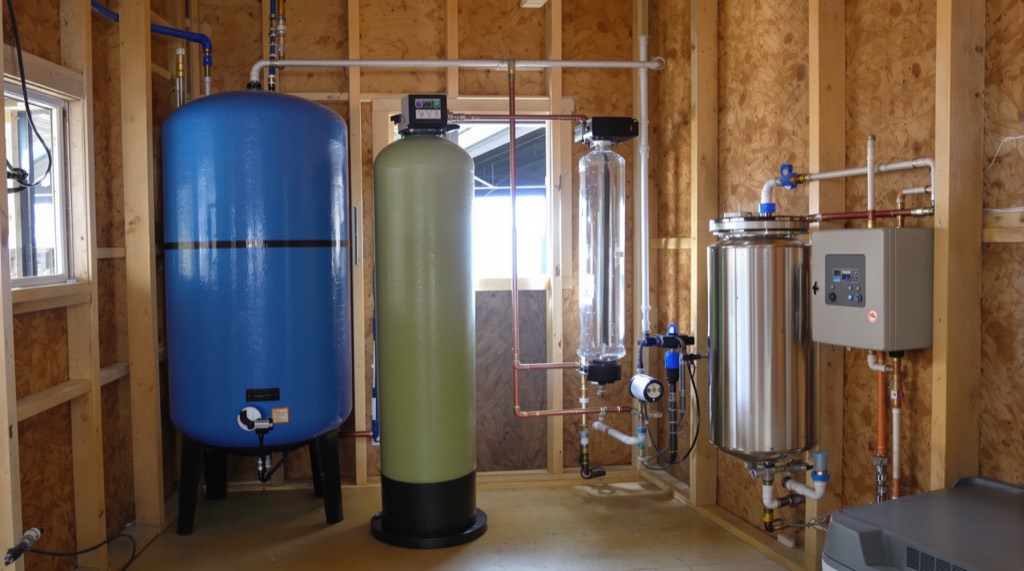
This is where well systems succeed or fail, and it is not a matter of taste. Each stage protects the next one.
Pre-treatment limits are the manufacturer’s own, from VIQUA UV system owner’s manual 520104_RevAD.
No. EPA notes that private well water is not regulated federally or by most states, and South Carolina’s well regulation covers construction and operation rather than water quality.
The state’s own well-record clause asks for chemical or bacterial results “if taken”. If you are on a well, you are the only one checking, and a state-certified lab test costs about $20 for coliform and $50 for a minerals and metals panel.
Annually for total coliform bacteria, nitrate and total dissolved solids — plus a broader panel when you first take the well on.
That first panel should cover arsenic, chloride, copper, fluoride, hardness, iron, lead, manganese, nitrate, pH, radium, sodium, sulphate, coliform, TDS and uranium. Test again after any flooding, and look at the water monthly for cloudiness, colour, odour and taste.
Hydrogen sulphide, usually — and the treatment is oxidation followed by filtration rather than carbon alone.
Air injection systems handle it without chemicals. We would not put a figure on how common it is in South Carolina wells, because no reliable state-level study exists and inventing one would be worse than saying so.
Orange or red staining is normally iron. Black or brown staining is normally manganese, which stains at very low concentrations.
Both are treated by oxidation and filtration rather than by a softener, though a softener handles small amounts of dissolved iron. Nearly a quarter of Piedmont bedrock wells exceed the secondary standard for manganese, which makes it a common and under-diagnosed problem in York County.
A typical full setup — sediment, iron removal, softener and an under-sink reverse osmosis unit — runs about $3,000 to $7,000 in national cost guides.
Individual stages: sediment $150 to $500, iron and manganese $1,000 to $3,500, ultraviolet $700 to $2,500, calcite neutraliser $800 to $2,500. Sourced ranges are on our Charleston and York County cost pages.
If the well has ever tested positive for coliform bacteria, yes — and it needs the right class.
NSF/ANSI 55 Class A delivers 40 millijoules per square centimetre and is intended to make unsafe water safe. Class B delivers 16 and is only supplemental for water that is already disinfected; it cannot make health claims at all. Ask which class you are being quoted.
Part of Southeastern Renovation's water treatment division. Published prices: Charleston · York County.